Content that AI determines to be an "authoritative information source" meets three criteria: clear supervision by experts, objective numerical data, and a logical heading structure. Generative AI searches like Google AI Overview and Perplexity prioritize content that satisfies E-E-A-T (Experience, Expertise, Authoritativeness, Trustworthiness) and includes unique information in short sentences with a "conclusion first" approach. This article systematically explains the conditions for information sources evaluated by AI from the perspective of structural design.
What are the three characteristics that AI considers to determine an "authoritative information source"?
AI determines an authoritative information source based on content that includes three elements: expert supervision, numerical data, and logical structure. AI searches prioritize information that is reliable, proven, and organized in an easily extractable format as the basis for their answers.
The main elements that indicate authority are as follows:
- Clear indication of supervision or authorship by experts
- Quotations from public or academic institutions
- Inclusion of specific numbers or objective data
- Clear indication of references and sources
- Logical organization of heading hierarchy
The mechanism for citation determination in AI searches can be checked in detail in the How to Check Citation Status in AI Searches.
What does it mean for AI searches to "reference"?
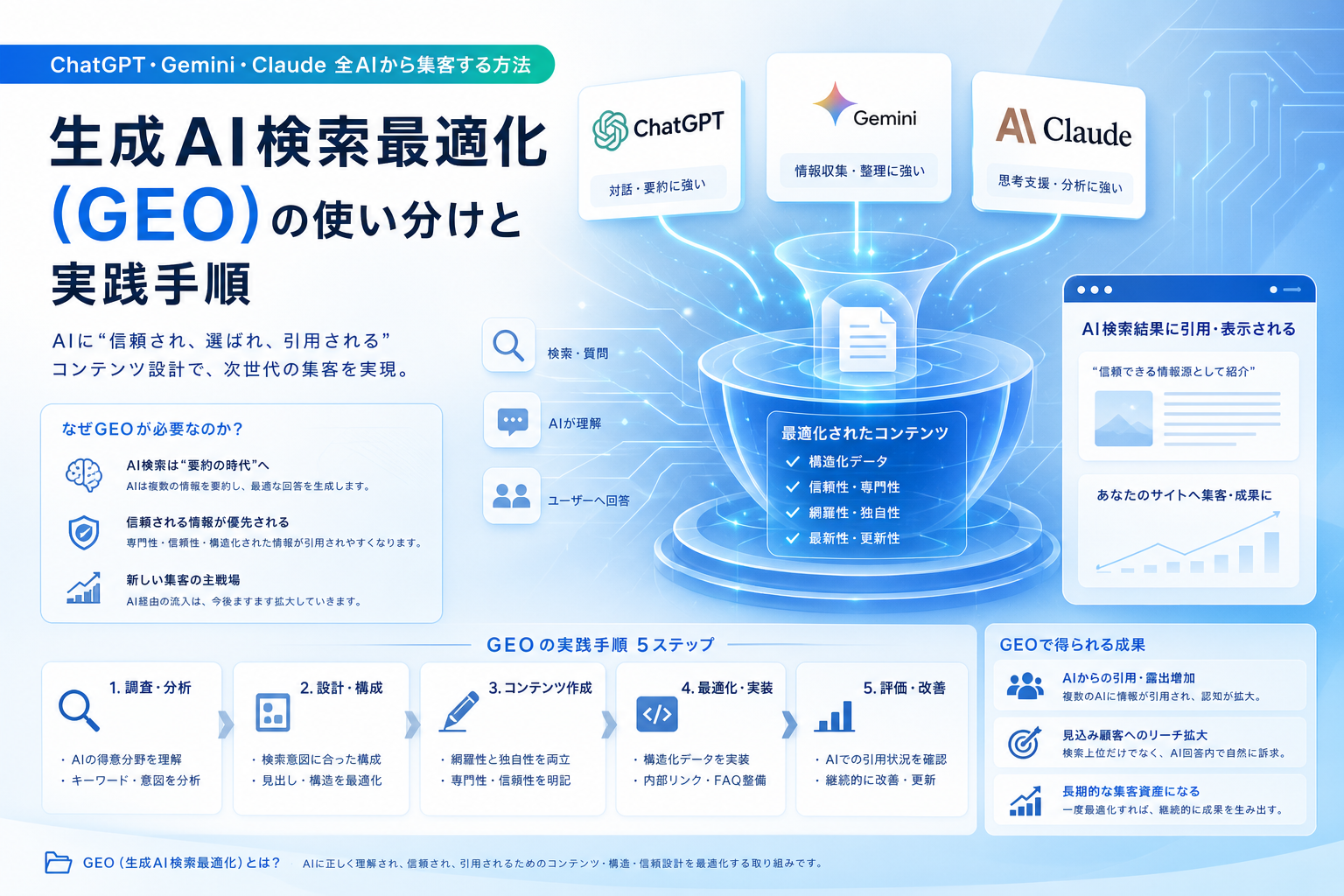
For AI searches to reference means that AI extracts and cites specific content as the basis for generating answers. Unlike traditional search rankings, AI summarizes multiple sources of information and incorporates reliable short sentences into its responses.
The basic structure of the referencing process is as follows:
- AI analyzes the user's question intent through natural language processing
- Collects multiple relevant information sources
- Extracts paragraphs with high reliability and specificity
- Summarizes and integrates the extracted content to generate answers
In other words, to be cited by AI, a "structure that is easy to extract" is more important than "higher ranking".
What are the conditions for information sources evaluated by AI, known as "E-E-A-T"?
E-E-A-T refers to the four elements of Experience, Expertise, Authoritativeness, and Trustworthiness, which are quality evaluation criteria. It is believed that AI searches utilize these four elements to assess the reliability of information sources.
The meanings of each element are as follows:
| Element | Content | How to Indicate |
|---|---|---|
| Experience | Primary information based on real experiences | Case studies, measured data |
| Expertise | Specialized knowledge in the field | Clear indication of expert supervision |
| Authoritativeness | Recognition and evaluation in the industry | Quotations from public institutions |
| Trustworthiness | Accuracy and transparency of information | Clear indication of references and update history |
Among these four elements, the value of primary information based on "experience" is particularly increasing in the era of AI searches.
What are the five characteristics of content that is likely to be cited?
The characteristics of content that is likely to be cited are: conclusion first, clear numerical data, FAQ format, logical structure, and clear indication of sources. AI determines that content meeting these criteria is easier to extract as the basis for answers.
Here are the five characteristics summarized:
- Place the conclusion in the first 1-2 sentences directly under the heading
- Avoid abstract expressions and indicate with specific numbers
- Directly answer anticipated questions in an FAQ format
- Logically structure the heading hierarchy
- Clearly indicate references and data sources
Specific practical methods in the B2B domain are systematically explained in the Complete Guide to LLMO for B2B Companies.
What are the characteristics of information sources that are not chosen by AI?
Information sources not chosen by AI are those where the conclusion is placed later, the source is unclear, and there are many abstract expressions. AI risks terminating the processing of content where the conclusion is placed later, making articles with unclear structures less likely to be cited.
The main characteristics of content that AI avoids are as follows:
- The conclusion is placed at the end of the document or in the latter half of the article
- No numbers or data are included
- No reference or author information is provided
- Paragraphs exceed 300 characters and are redundant
- The correspondence between headings and body text is ambiguous
Conversely, simply avoiding these characteristics increases the likelihood of being cited.
What is the basic principle of AIO content: "Conclusion → Evidence → Details → Examples → Cautions"?
The basic principle of AIO content consists of a five-step structure: "Conclusion → Evidence → Details → Examples → Cautions". AI finds it easier to extract information that places the conclusion at the beginning, so it is recommended to modularize each section in this order.
The roles of the five steps are as follows:
- Conclusion: Assert the answer at the beginning
- Evidence: Support with numbers or sources
- Details: Explain the mechanism and background
- Examples: Provide specific cases
- Cautions: Clearly state prerequisites or exceptions
Repeating this order under each heading is key to improving citation rates.
How to write sentences that are likely to be cited?
Sentences that are likely to be cited are in the form of declarative sentences that are self-contained in 1-2 sentences and include proper nouns and numbers. AI's highlight extractor prefers self-contained short sentences of about 40-200 characters, so it is important to avoid long modifiers.
The main principles of writing are as follows:
- Clearly state the subject and complete the sentence in one statement
- Avoid making sentences long with adverbs or conditional clauses
- Keep the average paragraph length below 300 characters
- Include proper nouns and numerical values in the text
- Use questions in headings and place answers directly below
Practical checks for sentence design can refer to Information Design for AI Citation.
What is information modularization?
Information modularization means designing each paragraph as an independent unit of information that makes sense on its own. Since AI extracts information at the paragraph level, self-contained paragraphs that do not depend on the surrounding context are more likely to be cited.
The key points of modularization are as follows:
- Focus each paragraph on one topic
- Place the conclusion at the beginning of the paragraph
- Avoid using reference expressions to previous paragraphs
- Include numbers and proper nouns in each paragraph
This ensures that any paragraph extracted by AI stands as accurate information.
Why is the FAQ format valued by AI?
The FAQ format is valued by AI because questions and answers correspond one-to-one, making extraction easy. AI searches prefer structures that can directly answer user questions, so FAQs that answer anticipated questions are more likely to be cited.
The key points for FAQ design are as follows:
- Make questions resemble actual search queries
- Keep answers concise and assertive in 1-2 sentences
- Provide simple explanations for technical terms
- Include multiple FAQs on one page
Optimization methods for FAQ pages are detailed in Structural Design of FAQs Cited by AI Searches.
How does structured data affect AI evaluation?
Structured data assists AI in accurately understanding the meaning of content. By implementing schemas for FAQs and HowTo, AI can more easily grasp the content structurally, increasing the likelihood of being recognized as a citation candidate.
The main types of structured data are as follows:
- FAQPage: Clearly indicates the correspondence between questions and answers
- Article: Clearly indicates author, publication date, and update date
- Organization: Clearly indicates information about the operating organization
- BreadcrumbList: Clearly indicates the page hierarchy
However, it is important to note that structured data is merely an aid, and the quality of the main text is a prerequisite.
Why are update frequency and freshness important?
Update frequency and freshness are important because AI tends to prioritize new information. By clearly indicating the update date and revision history, the reliability of the content is believed to increase.
The main points for freshness management are as follows:
- Clearly state the publication date and last update date
- Regularly review outdated numbers and examples
- Record revision content as history
- Write years based on the latest standard of 2026
Information that is frequently updated should avoid definitive statements and be written as general observations.
What is the new metric called AI Visibility?
AI Visibility is a new metric that measures how often a brand is found, mentioned, and cited on AI interfaces. While traditional SEO focused on traffic volume, AI Visibility emphasizes the qualitative impact of "how AI describes the company".
The indicators to look at for AI Visibility are as follows:
- Mention Rate: The percentage of mentions in AI responses
- Site Citation Rate: The percentage of citations as evidence
- Share of Voice: Comparison of mentions against competitors
- Sentiment Score: The tone when mentioned
As search behavior changes significantly, the importance of this metric is expected to continue to rise.
What is a simple method to check your own content?
Checking your own content starts with verifying four points: the position of the conclusion, the presence of numbers, paragraph length, and author information. By simply checking whether these are met, you can get a rough idea of how well your content is prepared for AI citation.
The simple checklist is as follows:
- Is there a conclusion directly under each heading?
- Does each paragraph contain numbers or proper nouns?
- Is the average paragraph length below 300 characters?
- Is author or supervisor information clearly stated?
- Are there three or more FAQs included?
For systematic diagnosis, utilizing the LLMO Countermeasure Diagnosis Checklist is effective.
Summary: What are the key factors for being judged as an authoritative information source?
The key factors for being judged as an authoritative information source are meeting five elements: expert supervision, objective numbers, logical structure, clear indication of sources, and appropriate updates. AI searches cite "easily extractable and reliable short sentences" rather than rankings, making a conclusion-first modular design essential.
Here are the key points summarized:
- Prove reliability with the four elements of E-E-A-T
- Place the conclusion directly under each heading
- Keep paragraphs self-contained and under 300 characters
- Clearly indicate numbers, proper nouns, and sources
- Directly answer anticipated questions in FAQ format
Content that meets these criteria will become a "cited information source" in the era of AI searches.
Frequently Asked Questions (FAQ)
What is the biggest condition for AI to determine an authoritative information source?
The coexistence of expert supervision and objective numerical data. AI judges content that meets E-E-A-T and has clear sources as highly reliable.
Will high search rankings guarantee citations by AI?
High rankings do not necessarily guarantee citations. AI prioritizes "easily extractable and reliable short sentence structures" over rankings, so a conclusion-first design is necessary.
What is the appropriate paragraph length?
An average of 300 characters or less is recommended. Since AI extracts information at the paragraph level, it is important to summarize each paragraph concisely with one topic.
How much does author information influence citations?
Author information is important as proof of authority. It is said that 75% of pages with high citation rates include author information, and clearly stating qualifications and backgrounds enhances reliability.
Is the FAQ format really effective?
The FAQ format is effective because questions and answers correspond one-to-one, making them easy to extract. 75% of pages with high citation rates include three or more FAQs.
Is structured data essential?
It is not essential but effective. Schemas like FAQPage and Article assist AI in understanding content, but the quality of the main text is a prerequisite.
What specifically does information modularization entail?
It involves making each paragraph an independent unit of meaning that does not depend on context. Placing the conclusion at the beginning and avoiding reference expressions is key.
What is the ideal update frequency?
There is no clear standard, but regular reviews of outdated numbers and examples are recommended. Clearly stating publication and last update dates also helps improve reliability.
How is AI Visibility measured?
It is measured using indicators such as mention rate, site citation rate, share of voice, and sentiment score. However, there are still challenges regarding data transparency from the platform side.