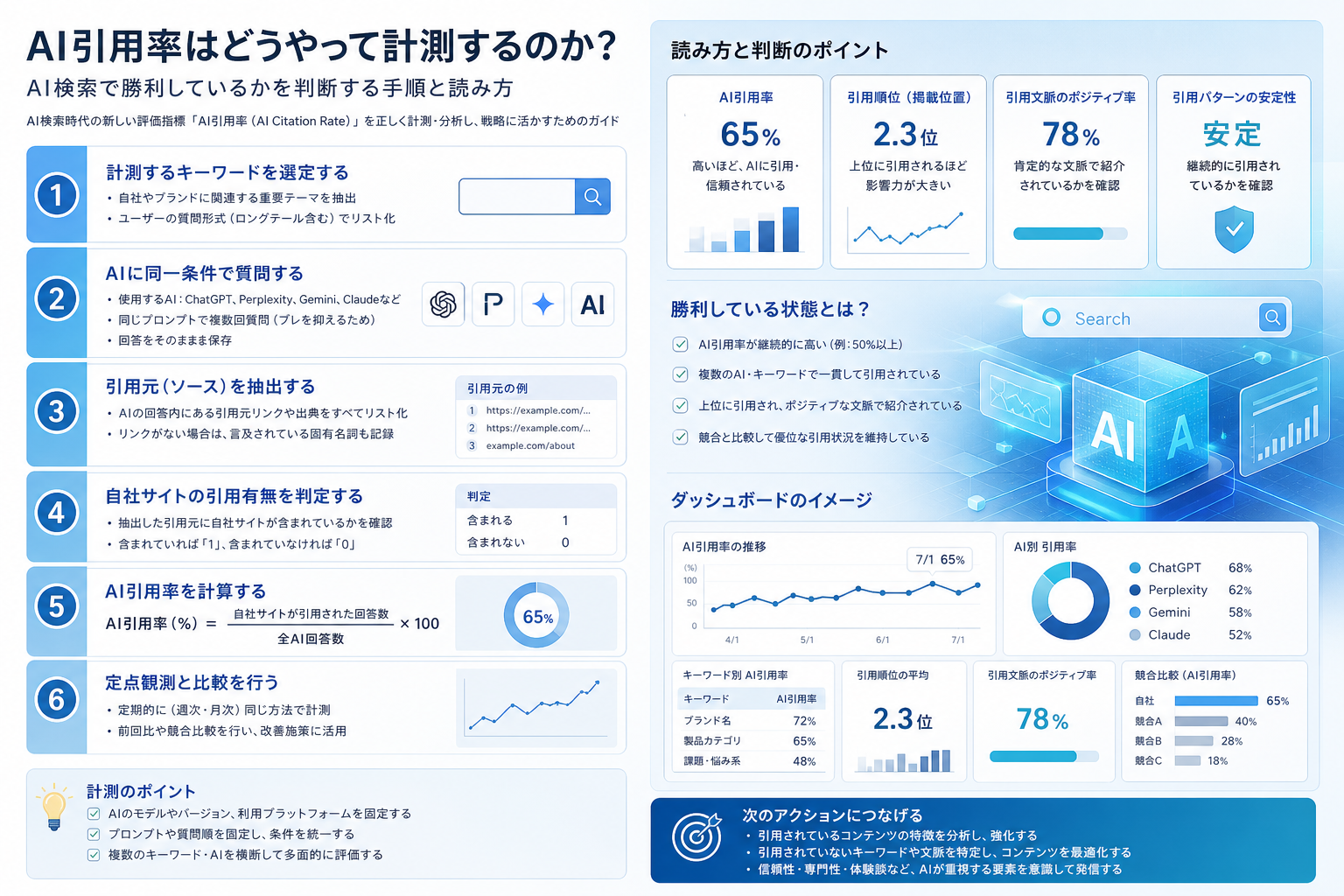
The "citation rate" in AI search refers to the percentage of times a company's information is referenced as a source when generating answers by tools like ChatGPT, Perplexity, and Google AI Overview. Measurement is typically based on a combination of three axes: "dedicated tracking tools," "manual scoring," and "GA4 referrer analysis." For example, if a company's information is cited in 7 out of 10 questions, the citation rate is calculated as 70%. Instead of ranking, recording the "source URL" and "mention of the company name" is the standard method for measuring effectiveness in the AI search era.
What does AI citation rate refer to?
The AI citation rate is a metric that quantifies the percentage of times a company's site is cited or referenced in answers from AI searches. If cited in 6 out of 10 questions, the citation rate would be 60%.
AI search differs from traditional search rankings in that it embeds sources within the answers themselves. Therefore, it is necessary to measure not "what rank the company is" but "whether the company was used in the answer."
If you want to systematically understand how to check citation rates, the method for checking citation status in AI search can also be helpful.
What is the difference between citation and mention?
A citation refers to "the URL being displayed as a source," while a mention refers to "the brand name appearing in the answer text." It is important to measure both separately.
- Citation: The company's URL is displayed as a source link
- Mention: The company's brand name or service name appears in the text
- Both: Both the URL and brand name appear
Why can't traditional metrics measure this?
In AI search, there is an increase in answers that do not involve clicks, making it impossible to grasp visibility using only search rankings or click counts. A new metric, the citation rate, is necessary.
What are the main metrics to measure?
When measuring AI citation rates, it is fundamental to look at four metrics: "company citation rate," "brand mention rate," "competitive comparison display rate," and "accuracy of citation context."
| Metric | Content | Calculation Example |
|---|---|---|
| Company Citation Rate | The percentage of times the company's URL appears as a source | 20% from 6 out of 30 questions |
| Brand Mention Rate | The percentage of times the company name appears in the text | 30% from 9 out of 30 questions |
| Competitive Comparison Display Rate | The percentage of times displayed alongside competitors | Frequency of appearing alongside Competitors A and B |
| Accuracy of Citation Context | Qualitative evaluation of whether the citation content is accurate | Check for any misidentifications |
By separating the citation rate from the mention rate, you can distinguish whether the issue is a lack of brand recognition or a lack of content.
What is the significance of analyzing by citation type?
By classifying citation types as "name only," "URL only," or "both," the location of the issues becomes clear. If there are many instances of URL only, strengthening brand recognition is the challenge.
What are the manual confirmation methods and their limitations?
Manual confirmation involves executing AI searches multiple times with a fixed list of keywords and prompts, scoring the occurrences of the company in the answers. Conducting this once a week with 5 to 10 target keywords is considered a realistic operational load.
What are the steps for manual confirmation?
Manual confirmation involves fixing the prompt, testing multiple times, and recording the occurrence rates. To maintain reproducibility, the persona and conditions should be fixed.
- Create a list of keywords for investigation (5 to 10)
- Prepare a fixed prompt with a fixed persona and conditions
- Obtain answers from each AI search
- Classify into company, competitors, and third-party sites
- Record the presence or absence of citations in a spreadsheet and score them
What are the limitations of manual confirmation?
Manual confirmation is labor-intensive, and the variability of answers and missed checks can lead to unstable accuracy. For continuous measurement, it is practical to use dedicated tools in conjunction.
What can be measured with dedicated tools?
Dedicated tracking tools automatically track the frequency of brand names and URLs mentioned in AI searches and AI chatbots. "Ahrefs Brand Radar" is available for $199 per month on the Standard plan.
What can Brand Radar do?
Brand Radar automatically tracks and visualizes brand mentions across multiple AI platforms. It can reduce the labor involved in manual confirmation.
- Automatic tracking of mention frequency in AI search engines and chatbots
- Monitoring the appearance of brand names and URLs
- Recording the trend of citation numbers over time
What are the steps to set up Brand Radar?
Setup proceeds in three steps: prompt design, platform selection, and regular report settings. Narrowing down the tracking targets increases accuracy.
- Step 1: Design the prompts (keywords) you want to track
- Step 2: Choose tracking platforms like ChatGPT, Perplexity, and Gemini
- Step 3: Set up automatic delivery of regular reports, such as monthly
How is referrer analysis conducted in GA4?
In GA4 referrer analysis, inflow data from AI search engines like Perplexity and Google AI Overview is monitored regularly. The number of sessions and CVR via AI is evaluated for quality compared to Organic Search.
How to view session numbers by AI search domain?
Extract AI search domains from the referring media report and understand the session numbers by domain. This quantifies the reality of inflows.
- Extract referrers like chatgpt.com / perplexity.ai
- Record the number of sessions via AI search monthly
- Compare the CVR via AI search with Organic Search
How to design a custom report?
Creating a custom report filtered by AI search domains allows for continuous tracking of inflow trends. The analysis methods for inflows and effects are detailed in the analysis methods for inflows and effects from AI searches.
How is the citation rate calculated?
The citation rate is calculated as "number of times cited ÷ total number of questions × 100." If cited in 6 out of 30 questions, the rate is 20%; if cited in 7 out of 10 questions, it is 70%.
What are specific calculation examples?
By fixing the number of questions, it becomes easier to compare citation rates.
| Total Questions | Number of Citations | Citation Rate |
|---|---|---|
| 10 questions | 7 citations | 70% |
| 30 questions | 6 citations | 20% |
| 30 questions | 9 citations | 30% |
When the numbers are small, it is important to increase the total number of questions and standardize the sample for comparison.
What are the characteristics of sites that are easily cited by AI?
Sites that are easily cited by AI possess four elements: "they have primary information," "the information is structured," "they are referenced externally," and "the last update date is recent."
Why is having primary information strong?
Primary information such as unique data, research results, and performance metrics cannot be substituted by other sites, making it easier for AI to reference it as a reliable source.
Why is structuring information important?
Information organized with heading hierarchies, bullet points, and tables makes it easier for AI's highlight extractors to pick out key points.
- Organize topics one by one with H2/H3 headings
- Clearly present numbers and definitions in tables or bullet points
- Place conclusions in short sentences directly under each heading
If you want to inspect the overall structure of your site, the LLMO countermeasure diagnostic checklist can be helpful.
How to design a cycle for continuous measurement?
Measurement should be conducted in a monthly cycle of "measurement → analysis → improvement," which forms the foundation for visualizing effectiveness. Instead of one-off checks, accumulate data and run the PDCA cycle.
How to set KPI benchmarks?
It is considered realistic to start with modest benchmarks in the first year and then raise them in the second year and beyond.
| Period | Monthly Citation Acquisition | Ratio of Inflows via AI Search |
|---|---|---|
| First Year | More than 10 | More than 1% |
| Second Year and Beyond | More than 30 | 3-5% |
How to respond to keywords with low citation rates?
For keywords with low citation rates, improvements can be made by adding primary information and structuring content. If mention rates are low, enhancing brand information is effective.
A systematic approach in the B2B domain can be confirmed in the complete guide to LLMO for B2B companies.
Frequently Asked Questions (FAQ)
Q1. How often should the AI citation rate be measured?
Manual checks should be done weekly, and automated tools should be set to monthly. It is recommended to continuously accumulate data and run monthly improvement cycles.
Q2. Which should be prioritized, citation rate or mention rate?
It is basic to measure both separately. If there are many instances of URL only, strengthening brand recognition is the challenge; if there are many instances of brand name only, structural improvements to encourage citation become necessary.
Q3. Is there a way to measure citation rates for free?
Manual confirmation can be started for free. By executing AI searches multiple times with a fixed prompt, you can record the presence or absence of citations in a spreadsheet and score them.
Q4. Which AI searches should be targeted for measurement?
It is basic to measure across major AI searches such as ChatGPT, Perplexity, Google AI Overview, and Gemini. Since citation trends differ by AI, multiple comparisons are effective.
Q5. What should be done first to increase the citation rate?
First, measure the current state by calculating the citation rate, then proceed to add primary information and structure the information. Keeping the last update date recent is also believed to contribute to improved visibility.
Conclusion: Key Points for Measuring AI Citation Rate
Measuring the AI citation rate typically involves a combination of automated tracking with dedicated tools, manual scoring, and GA4 referrer analysis, quantified as "number of times cited ÷ total number of questions × 100." In the first year, aim for "more than 10 monthly citations" and "more than 1% inflow via AI search"; in the second year and beyond, aim for "more than 30" and "3-5%" as KPI benchmarks. Running a monthly cycle of measurement, analysis, and improvement is key to establishing effective measurement in the AI search era.
Author Information
This article was created by the LLMO Navi editorial team based on practical insights into LLMO (Large Language Model Optimization) and AI search strategies. We continuously provide information on checking citation status, measuring effectiveness, and improving sites in AI search.