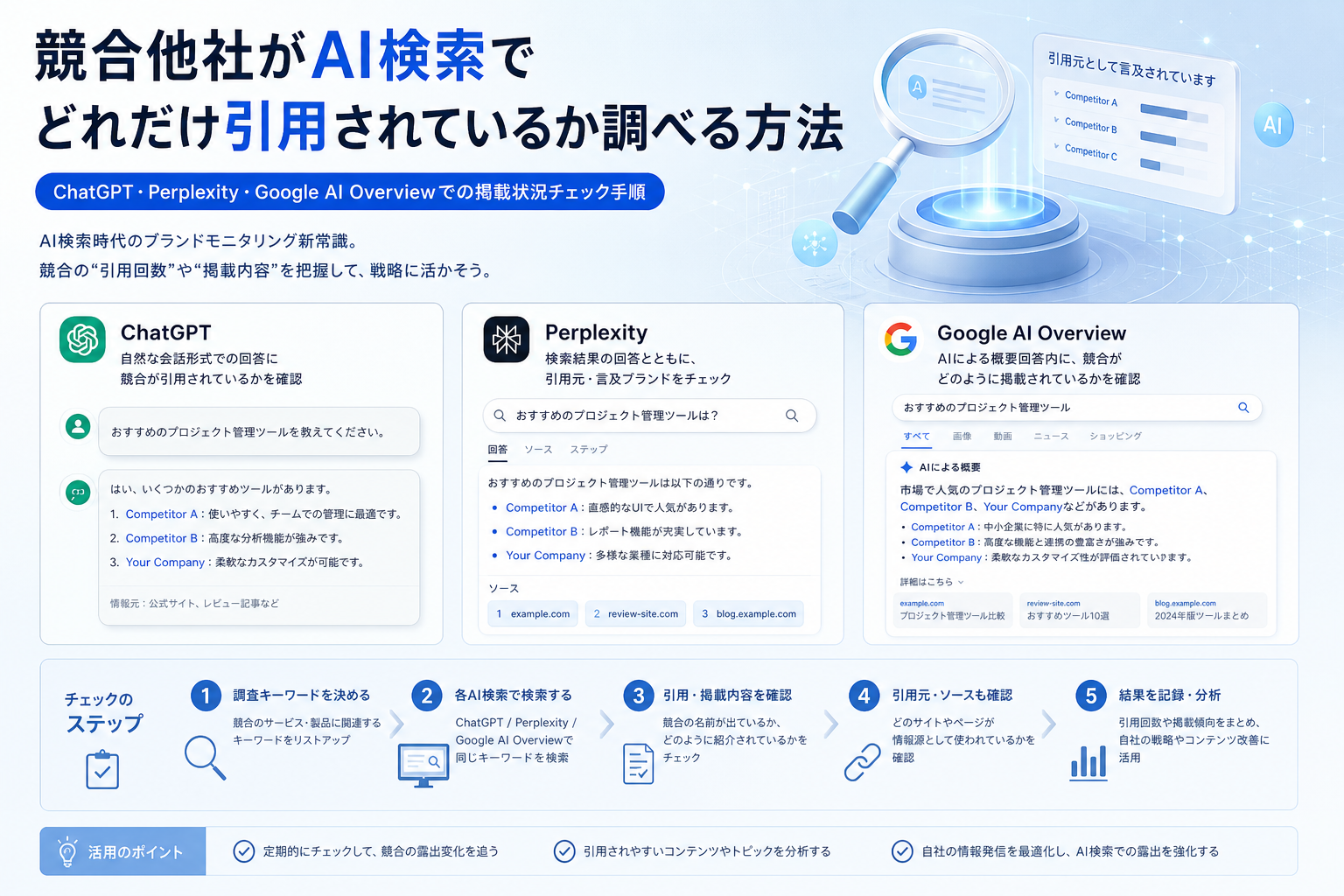
To investigate the situation where competitors are cited in AI searches, combine four steps: (1) directly asking ChatGPT or Perplexity, (2) checking the Google AI Overview in secret mode, (3) automatic collection via the Perplexity API, and (4) implementing dedicated measurement tools. Since there is no official check function for AI search listings, proactive research and monitoring are essential. This article explains specific steps that can be reproduced in practice.
Why is it necessary to investigate competitors' AI search citation status?
Since there are no official management tools for AI searches, the only way to find out which queries competitors are cited for is through proactive investigation. Traffic from ChatGPT, Perplexity, and Google AI Overview represents a new competitive area that differs from traditional SEO.
- You can grasp how many times competitors are "recommended" by AI.
- You can identify query areas where your company is not cited.
- You can gain hints on content structures that are trusted by AI.
Being referenced by citation-based AIs like Perplexity is considered evidence that your content is evaluated as "trustworthy content (E-E-A-T)" by AI. The steps to understand your company's situation can also be referenced in the AI Search Citation Status Check Guide.
Research Method 1: Directly ask ChatGPT to check citation status
The simplest and most reliable method is to directly ask ChatGPT, "What are the recommended services in this field?" and check if competitors appear in the response.
Effective Question Examples
- "Tell me about recommended services in {industry name}."
- "Compare tools that solve {problem}."
- "What are the well-regarded {industry} in {region}?"
Checkpoints for Displayed Content
- Is the name of the competitor included in the response?
- In what context (recommendation, comparison, caution) are they mentioned?
- Does your company appear or not?
It is important to ask questions in "natural language" that users would actually use. Test with conversational inquiries rather than search keywords.
Research Method 2: Check sources with evidence on Perplexity
Perplexity explicitly states reference URLs (source links) in its answers, allowing you to check whether competitor domains are cited "with evidence." It is ideal for investigating the listing status of citation-based AIs.
Points to Check
- Is the name of the competitor included in the response?
- Is the competitor domain displayed in the reference link section?
- What is the citation rank (position of the source)?
Searching in secret mode (private window) eliminates the influence of login information and personalization. Try the same query multiple times to check for stability in the display.
Research Method 3: Check listing status on Google AI Overview
To see if competitors are mentioned in Google's AI Overview (AIO), search for the target query in the browser's secret mode. Check both the main text of the AI overview and the reference links.
Research Steps
- Open Google in secret mode.
- Search for the target keyword.
- Check if the AI Overview is displayed.
- Verify mentions in the text and the competitor domains in the reference links.
The AI Overview display results can vary based on user attributes and timing. It is recommended to check multiple times and in multiple environments rather than making a judgment based on a single check. The impact of traffic from AI searches is detailed in the AI Search CTR Analysis Guide.
Research Method 4: List 100 industry questions and throw them to AI
By listing not only major keywords but also 100 industry-specific questions and throwing them all to AI, you can comprehensively grasp the citation status. This can be done manually or automatically.
- Prepare 100 natural language questions that customers actually use.
- Throw the same questions to ChatGPT, Perplexity, and Google AI Overview.
- Count the number of times competitors appear in each response.
- Identify query areas with high appearance rates as competitors' "strengths."
By gathering 100 industry-specific questions, you can visualize competitors' citation patterns in a broader context rather than in isolated points.
Research Method 5: Automate citation analysis with the Perplexity API
If you have development resources, you can use the Perplexity API to automatically obtain answers and reference URLs, quantifying citation frequency. This method goes beyond the limits of manual checks.
Steps to Analyze Citations with the Perplexity API
- Prepare a list of research queries (questions).
- Use the API to obtain answers and reference URLs for each query.
- List the output domains.
- Count and aggregate the occurrences of competitor domains.
In one practical case, a total of 39 URLs were analyzed with four patterns of prompts, reporting that the investigation was conducted at a low cost of about 1 yen per question (about 30 yen for 10 keywords × 4 patterns). Using the API allows for accurate tracking of how many times competitor URLs were output.
AI search responses change every month, so regular checks are essential
AI search responses change rapidly due to model updates, so it is recommended to conduct investigations at least once a month. It is important not to rely on a single result.
- Reference sources may change with AI model updates.
- New competitor content may be reflected.
- Responses may fluctuate due to seasonal factors and trends.
Through continuous monitoring, you can track the trends in competitors' citation shares over time.
List of tools that can automatically investigate competitors' AI search citation status
If you have 100 keywords, manually checking is realistically impossible, so it is common to use dedicated tools for automatic measurement. Here is a comparison of major tools.
| Tool Name | Main Features | Supported Platforms |
|---|---|---|
| yoriaiSEO | Visualization of AI awareness share, identification of true competitors, and AI traffic contribution. | Google AI Overview |
| Brand Radar (Ahrefs) | Quantification of brand mentions and confirmation of competitor citation status. | General AI search |
| Peec AI | Monitoring brand mentions in AI searches. | Multiple AI searches |
| Otterly.AI | Tracking brands and citations within AI responses. | Multiple AI searches |
| Perplexity API | Automatic collection of answers and reference URLs, quantification of citation frequency. | Perplexity |
yoriaiSEO is expected to launch dedicated analysis functions in Japan in March 2026, allowing visualization of three important data points: AI awareness share of your site, true competitor media evaluated by AI, and AI traffic contribution.
What are the three points to consider when choosing a tool?
When selecting a tool, compare based on (1) desired features, (2) supported platforms, and (3) price and measurement counts. Choosing according to your purpose is important.
Select based on desired features
- Is it enough to just confirm existence, or do you want improvement advice as well?
- Do you need competitor identification features?
- Is automation of reports necessary?
Select based on supported platforms
- Does it support Google AI Overview?
- Does it support ChatGPT and Perplexity?
- Can it measure multiple AIs across platforms?
Select based on price and measurement counts
- The balance between monthly fees and the number of keywords measured.
- If using the API, the cost per question (about 1 yen in the case study).
What are the characteristics of content that is easily cited by AI?
Content that is easily cited by AI is "structured content" that places conclusions at the beginning and provides information in complete paragraphs. AI prefers specific information that can be used immediately for answers.
- Answer First: Place the answer at the beginning.
- Utilize question-form headings.
- Include comparison tables, FAQs, and step-by-step procedures.
- Modularize information by completing it in paragraph units.
- Present primary information and specific numbers.
The GEO paper from Georgia Tech shows that adding statistical data and citations improves reflection rates and citation rates (citation rate +30%, visibility +37%). Specific improvement measures can be found in the LLMO Countermeasure Diagnosis Checklist.
What can we learn from competitors' AI citation patterns?
By analyzing the queries and contexts in which competitors are cited, you can clarify the content elements that your company lacks. Compare the differences between cited articles and those that were not.
- List the query areas where competitors are cited.
- Analyze the structure (headings, tables, FAQs) of cited competitor pages.
- Identify the information modules that your company lacks.
- Check for the presence of question-form headings, comparison tables, and FAQs.
It has also been pointed out that there is a gap between content cited by AI and content that humans find valuable. Practical strategies for the B2B domain can be referenced in the B2B Companies' LLMO Countermeasure Practical Strategy.
What AI search optimization (LLMO) measures should be taken after the investigation?
Once you understand the citation status, you can start improving content (LLMO) to be chosen by AI. The specific axes for improvement are clear.
- Increase the number of question-form headings.
- Structure and add comparison tables and FAQs.
- Place conclusions at the beginning of each section.
- Clearly state proper nouns and specific numbers in the text.
- Break paragraphs into units of 300 characters or less.
The overall improvement steps for the site are systematically explained in the Site Improvement Measures to Be Cited by AI.
Frequently Asked Questions (FAQ)
Can I check competitors' AI search citation status for free?
Yes, you can. Direct checks in secret mode using ChatGPT, Perplexity, and Google AI Overview are free. For comprehensive and continuous research, using dedicated tools or APIs (about 1 yen per question in the case study) is efficient.
Can I check competitors' AI citation status in Search Console?
No, you cannot. Search Console cannot distinguish traffic from AI, nor can it track competitors' citation status. Since there is no official check function for AI searches, external tools or direct investigations are necessary.
Should I use ChatGPT or Perplexity for research?
It is recommended to use both. ChatGPT is suitable for checking mentions in response texts, while Perplexity is appropriate for checking reference links (with evidence). Adding Google AI Overview to the three checks increases accuracy.
How often should research be conducted?
At least once a month is recommended. AI search responses change rapidly due to model updates, so it is important to continuously monitor rather than rely on a single result.
Why search in secret mode?
To eliminate the influence of login information and personalization. In normal mode, past search history and account information can affect results, making it difficult to objectively grasp competitors' citation status.
What is the cost of using the Perplexity API for research?
In practical cases, research has been conducted at about 1 yen per question (about 30 yen for 10 keywords × 4 patterns). The advantage is that you can automatically analyze a large number of keywords at a low cost, which is difficult to do manually.
If competitors are cited by AI, what should I do?
Analyze the structure of the cited competitor pages (headings, comparison tables, FAQs, numbers) and supplement the information modules that your content lacks. Introducing question-form headings and an answer-first structure is considered effective for improving citation rates.
What specific benefits come from being cited by AI?
It serves as evidence that your content is evaluated as trustworthy content (E-E-A-T) by AI, creating opportunities for traffic from AI searches. Citations in Google AI Overview can also be seen as opportunities for your site to be officially recommended.
Conclusion: Key Points for Competitors' AI Search Citation Research
The citation status of competitors in AI searches can be grasped through four steps: directly asking ChatGPT and Perplexity, checking Google AI Overview in secret mode, using the Perplexity API (about 1 yen per question), and utilizing dedicated tools. Since there is no official check function for AI searches, regular investigations at least once a month are essential.
Based on the data obtained from the research, implementing LLMO measures such as structuring question-form headings, comparison tables, and FAQs, placing conclusions first, and clearly stating specific numbers can lead to an increase in your citation rate. Domestic tools like yoriaiSEO are expected to launch dedicated analysis functions in March 2026, visualizing AI awareness share, true competitors, and AI traffic contribution. Starting with direct questions that can be done for free and gradually introducing APIs and tools according to scale is a realistic approach.