
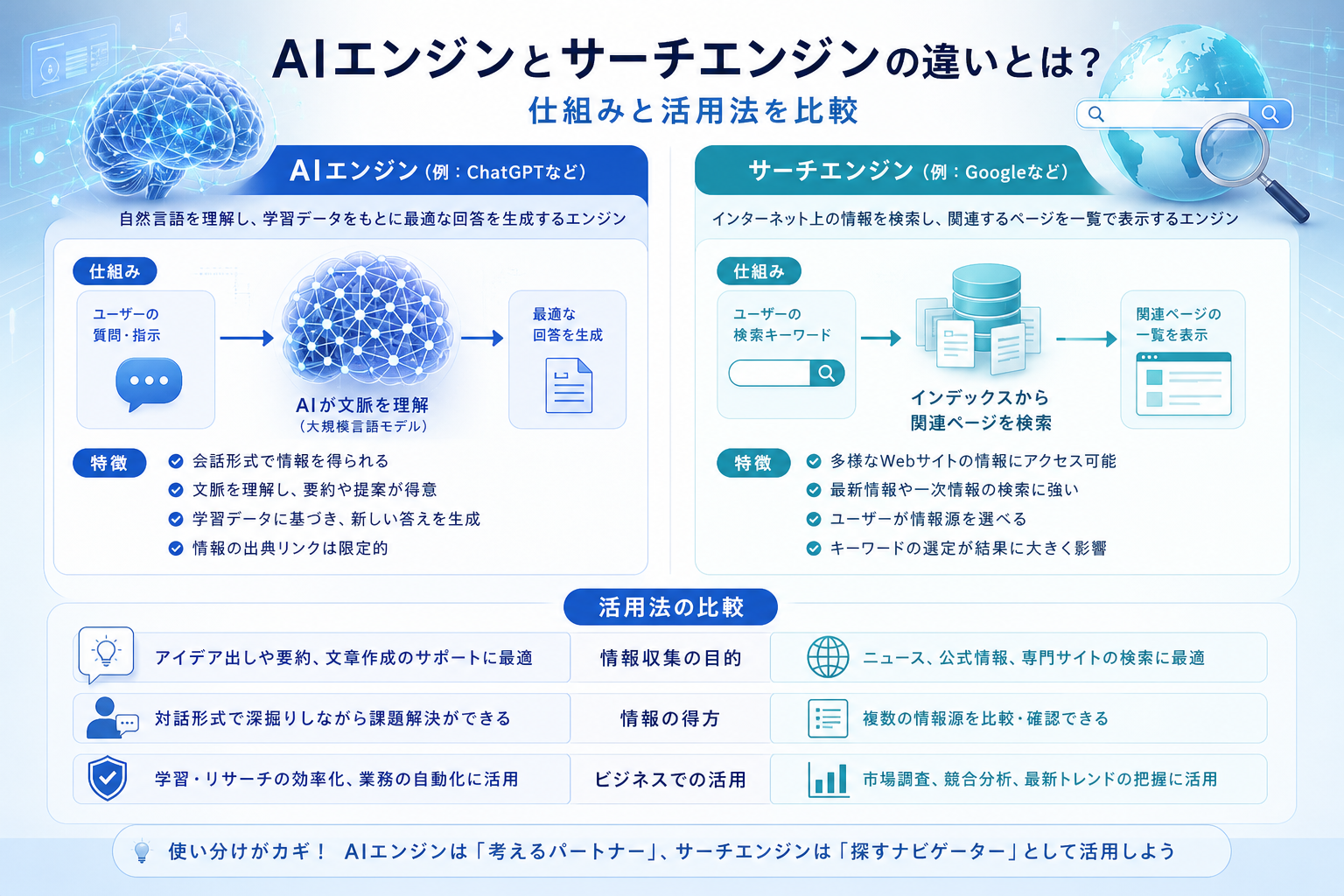
The fundamental difference between AI engines and search engines lies in whether they "find information and tell you where it is" or "summarize and generate answers." Search engines list pages that match keywords, while AI engines integrate multiple pieces of information using large language models to generate answers. This article organizes the mechanisms, benefits, and distinctions between the two, including handling primary information such as the original text of government law revisions (2024 edition) and the 2025 forecast report for the generative AI market, and presents a guide for choosing based on purpose.
What are the fundamental differences between AI engines and search engines?
Search engines serve the role of "telling you where and what information is available (providing locations)," while AI engines serve the role of "directly organizing information and answering (creating reports)." The former helps reach official product catalogs (PDF) from 2024 and the latest statistical data published by the Ministry of Health, Labour and Welfare, while the latter generates a 5-minute summary report that compiles industry trends.
The two are not in opposition but should be used according to the purpose. It is also beneficial to confirm the organization of terms and differences that serve as a premise for AI search measures to deepen understanding.
The two roles of "searching" and "generating"
Search engines present around 10 links in the search results, allowing users to compare them themselves. AI engines integrate information from multiple sources and present it as a single answer.
Differences in representative services
- Search engines: Google, Bing, etc.
- AI engines: ChatGPT, Perplexity, Gemini App, etc.
How do search engines work?
Search engines accurately reach breaking news articles reported by major newspapers and the latest statistical data published by the Ministry of Health, Labour and Welfare by "telling you where and what information is available (providing locations)."
They crawl and collect web pages, index pages that match keywords, and display them in a ranked format. They are strong in confirming primary information and excel in situations where timeliness is required.
The flow of crawling and indexing
- Bots crawl web pages
- Collected pages are indexed
- Ranking is displayed based on keyword match
Situations where search engines excel
- Direct access to primary information such as the official product catalog (PDF) for 2024
- Verification of breaking news and official announcements
- Reaching specific companies' official websites
How do AI engines work?
AI engines achieve the automatic generation of comparison tables of functions with three competing companies and interactive FAQs that explain complex technical terms by "directly organizing information and answering (creating reports)."
Large language models (LLMs) read the context and intent of questions and integrate information from multiple sources through retrieval-augmented generation (RAG). How Google Search's AI mode operates can also be referenced in the explanation of the AI mode's mechanism.
Query understanding through natural language processing
AI engines analyze the intent of the entire sentence rather than just matching words. They can handle complex requests such as "a 5-minute summary report that compiles industry trends."
The mechanism of retrieval-augmented generation (RAG)
RAG generates answers by referencing external verified data, allowing the basis of the answers to be presented as source links.
What are the advantages and disadvantages of AI engines?
The advantage of AI engines is that they can significantly reduce research time through "interactive FAQs that explain complex technical terms" and "automatic generation of comparison tables of functions with three competing companies." On the other hand, there is a risk of generating information that differs from the facts, known as "hallucination."
Advantages: Efficiency and interactivity
- Reduces the effort of "searching," "reading," and "summarizing"
- Allows for condition changes and deeper exploration in a conversational format
- Instantly generates a 5-minute summary report that compiles industry trends
Disadvantages: The risk of hallucination
Since AI may generate information that differs from the facts, it is essential to verify important information with source links (primary information). It is safest to provide 100% source links based on official announcements and verify with a list of verified primary information sources.
How to prevent hallucination?
In reliable operations, "100% source links based on official announcements" and "fact-checking by experts for the third quarter of 2024" along with a "list of verified primary information sources" help suppress hallucination.
It is important not to trust AI engine responses as they are, but to verify with primary information. Answers with clearly stated sources are more trustworthy.
Basic steps for verification
- Open the source links attached to the AI engine's response
- 100% confirm the source links based on official announcements
- Cross-check with the list of verified primary information sources
How do companies differentiate between AI engines and search engines?
Companies can streamline their research tasks by obtaining "detailed examination: the original text of government law revisions (2024 edition)" through search engines and "overview understanding: the 2025 forecast report for the generative AI market" through AI engines.
Specific approaches in the B2B domain can be referenced in the LLMO measures that B2B companies should undertake.
Detailed examination is for search engines
- Verification of the original text of government law revisions (2024 edition)
- Reference to the latest statistical data published by the Ministry of Health, Labour and Welfare
- Tasks requiring accurate citation of primary information
Overview understanding and efficient research are for AI engines
- Overview understanding of the 2025 forecast report for the generative AI market
- Creation of comparison tables for the top 10 SaaS tools
- Automatic generation of comparison tables of functions with three competing companies
Successful patterns of AI utilization are also organized in the successful cases and points of AI business utilization.
Comparison table of AI engines and search engines
| Comparison Axis | Search Engine | AI Engine |
|---|---|---|
| Role | Tells you where and what information is available (providing locations) | Directly organizes information and answers (creating reports) |
| Output Format | List of pages matching keywords | A single integrated and summarized answer |
| Expertise Area | Official product catalog (PDF) for 2024, breaking news | 5-minute summary report compiling industry trends |
| Comparison Task | User manually compares readings | Automatic generation of comparison tables of functions with three competing companies |
| Ensuring Reliability | Direct access to official sites | 100% source links based on official announcements |
| Points of Caution | Requires crawling multiple sites | Verification against hallucination is necessary |
What points should companies keep in mind in the era of AI search?
With the spread of AI search, it has become important for companies to establish a "list of verified primary information sources" and provide "100% source links based on official announcements" in their information dissemination.
To be cited by AI engines, it is key to clearly indicate unique numbers and primary information. The impact of AI search on CTR is detailed in the CTR impact analysis guide.
Three axes for information organization
- Detailed examination: Retain the original text of government law revisions (2024 edition)
- Overview understanding: Provide the 2025 forecast report for the generative AI market in summary format
- Efficient research: Present a comparison table of the top 10 SaaS tools in structured data
Frequently Asked Questions (FAQ)
What is the biggest difference between AI engines and search engines?
The biggest difference is their roles. Search engines focus on "telling you where and what information is available (providing locations)," while AI engines focus on "directly organizing information and answering (creating reports)."
In what situations are search engines suitable?
They are suitable for direct access to primary information such as the official product catalog (PDF) for 2024 or breaking news articles reported by major newspapers, where timeliness is required.
In what situations are AI engines suitable?
They are suitable for overview understanding of complex themes such as a 5-minute summary report compiling industry trends or automatic generation of comparison tables of functions with three competing companies.
What is hallucination?
It is the phenomenon where AI generates information that differs from the facts. Important information must always be verified with source links (primary information) based on official announcements.
Can I trust the answers from AI engines as they are?
It is not recommended to trust them as they are. Verification with primary information is essential, such as using a list of verified primary information sources or fact-checking by experts for the third quarter of 2024.
What is retrieval-augmented generation (RAG)?
It is a mechanism that generates answers while referencing external verified data. This allows AI engines to present the basis of their answers along with source links.
Which should I use to look up important information like law revisions where accuracy is crucial?
For important information where accuracy is crucial, such as the original text of government law revisions (2024 edition), it is safest to verify the original text using search engines. AI engines can be used as a supplementary tool for overview understanding.
Conclusion: Key to Selection
AI engines and search engines should be differentiated based on their roles: "searching for information" by search engines and "generating information" by AI engines. Search engines excel at reaching primary information such as the official product catalog (PDF) for 2024 and the latest statistical data published by the Ministry of Health, Labour and Welfare, while AI engines streamline research through automatic generation of comparison tables of functions with three competing companies and 5-minute summary reports compiling industry trends. Providing 100% source links based on official announcements and verifying with a list of verified primary information sources is the key to preventing hallucination.