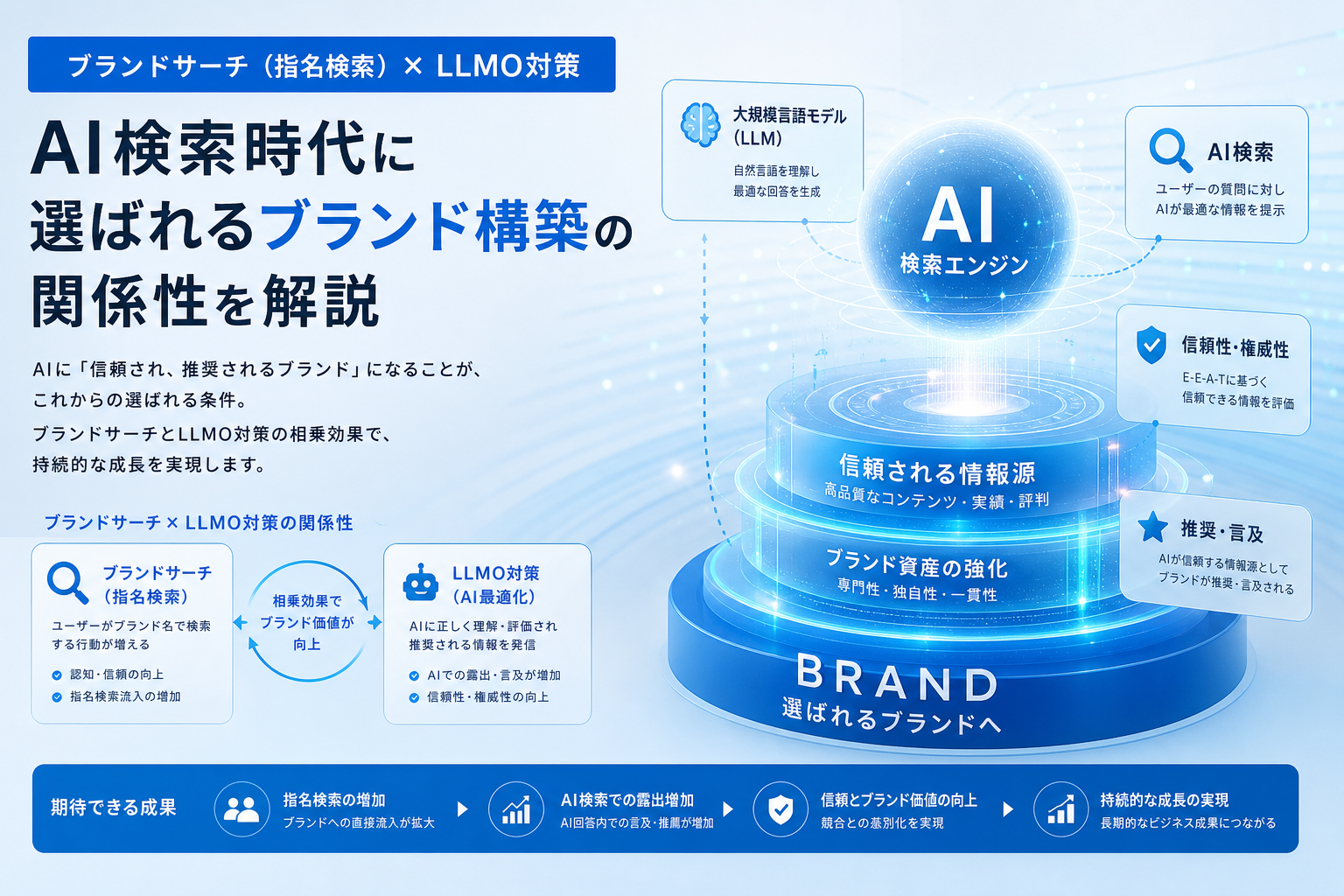
Brand search (name search) and LLMO measures mutually reinforce each other. As name searches increase, AI recognizes the brand as an "authoritative brand," leading to more recommendations in AI responses, which creates a positive cycle where users conduct name searches again after seeing those recommendations. This article structurally organizes the relationship between the two and explains the practical steps involved.
What is the relationship between brand search (name search) and LLMO?
The increase in name searches is one of the most important signals for AI to recognize a company as a "reliable primary information source." AI tends to judge brands with high name search volumes and external mentions as having high authority.
- Name search = direct search using brand names or service names
- LLMO = optimization for citation and recommendation by large language models
- Both circulate through "awareness → name search → AI recommendation → renewed awareness"
The specific steps for LLMO measures to increase name searches are detailed in How to Implement LLMO Measures to Increase Name Searches.
Why does AI prioritize brands with many name searches?
AI dislikes ambiguous information and prioritizes entities that are consistently mentioned across multiple information sources. Brands with many name searches accumulate external evaluations and citations, thereby strengthening their relevance within AI's learning and reference data.
- Many sites discussing the same brand name = evidence of trust
- Context accumulated with "category name + brand name"
- AI becomes more likely to associate "this brand with this category"
What are the three benefits that name searches bring to LLMO?
The increase in name searches provides three benefits to LLMO measures: increased citations, AI recommendations, and SEO synergy.
Increase in citations (external mentions)
When the company name is introduced in blogs, social media, and news sites, name searches increase, enhancing relevance within AI's reference data. Citations are the core of external evaluations in LLMO.
- Inclusion in comparison media
- Mention on review sites and social media
- Exposure in news and press releases
Reliable recommendations by AI
When asked, "What are the recommendations for this category?" brands that are frequently searched by name are more likely to be prioritized.
Synergy with SEO
The increase in name searches directly leads to improved brand authority in traditional Google searches, allowing for an advantage in both AI searches and traditional searches.
What is the cycle by which LLMO measures increase name searches?
When LLMO measures are successful, a flow cycle is created: AI recommendations → user name searches → traffic to the official site. This cycle accelerates as awareness increases.
- The company is recommended in AI responses
- Users directly search for the brand name (name search)
- Traffic flows to the official site, further increasing awareness
- Increased exposure generates the next name search
The status of your company's citations in AI searches can be diagnosed in How to Check Citation Status in AI Searches.
How do brand search and LLMO differ from SEO? [Comparison Table]
SEO aims for "search rankings and site traffic," while LLMO focuses on "citations and recommendations within AI responses." Name searches function as a common metric supporting both.
| Comparison Axis | Traditional SEO | LLMO Measures | Role of Name Searches |
|---|---|---|---|
| Purpose | Improving search rankings | Citations and recommendations in AI responses | Enhancing authority for both |
| Evaluation Target | Page level | Entity and brand level | Metric for brand awareness |
| Performance Indicator | Traffic and rankings | Citation count and mention rate | Change in name search volume |
| Source of Trust | Backlinks | Citations and consistent mentions | Volume of direct searches |
What are the characteristics of companies particularly effective in LLMO measures?
LLMO measures are considered highly effective for B2B companies with long consideration periods and high specialization, as well as brands that want to increase name searches.
- Industries where AI is used for information gathering during long consideration periods
- Companies that can share specialized knowledge or unique data
- Brands aiming for "top-of-mind" within their category
The importance of LLMO in the B2B sector is systematized in Complete Guide to LLMO for B2B Companies.
What common issues do brands that are not chosen by AI face?
Brands that are not chosen by AI share common traits of having little primary information, dispersed external mentions, and unclear entity information.
- No unique research data or case studies are being shared
- Inconsistent representation of company names and service names
- Lack of mentions in comparison and review contexts
How to implement LLMO measures to increase name searches?
Implementing LLMO measures to increase name searches involves four steps: understanding the current situation → sharing primary information → acquiring external evaluations → measuring effectiveness.
Step 1: Understanding the current situation
Check how AI is responding to your company and understand the current mention and citation rates.
Step 2: Sharing primary information
Share unique research data, specialized case studies, and performance metrics to enhance value as an "information source."
Step 3: Acquiring external evaluations
Create a situation where "when it comes to this category, it's our company" is consistently mentioned in comparison media, review sites, and social media.
Step 4: Measuring effectiveness
Continuously measure three indicators: number of name searches, number of mentions in AI responses, and traffic from AI sources.
Specific check items can be found in LLMO Measures Diagnostic Checklist.
How to measure the effects of name searches and LLMO?
Effectiveness is measured using three indicators: "changes in name search volume," "number of mentions in AI responses," and "traffic from AI sources." These indicate whether the positive cycle of name searches and LLMO is functioning.
- Name search volume: trends in direct searches using brand names and service names
- Mention count: citations and mentions in ChatGPT, Gemini, and AI Overview
- Traffic from AI: referral traffic from AI tools
Conclusion: How to create a positive cycle of name searches and LLMO
Name searches and LLMO measures create a mutually complementary relationship that generates a positive cycle of "AI recommendations → name searches → renewed recognition" through sharing primary information and acquiring external evaluations. To become a trusted information source for AI, it is essential to continue sharing unique data and accumulating citations.
- Share primary information to enhance value as a "source"
- Acquire consistent mentions in comparison and review contexts
- Measure three indicators: name searches, mention counts, and traffic from AI
Frequently Asked Questions (FAQ)
Q1. What is brand search (name search)?
Name search refers to the act of directly searching using the brand name or service name itself. Unlike general keyword searches, it is considered an indicator of an already established recognition and trust.
Q2. Why is name search effective for LLMO measures?
This is because AI tends to judge brands with high name search volumes and external mentions as having high authority. The frequency of name searches is considered one of the trust signals for AI.
Q3. Will LLMO measures increase name searches?
When the company is recommended in AI responses, it creates a flow where users directly search for the brand name. This is expected to lead to a positive cycle resulting in an increase in name searches.
Q4. What should I start with to increase name searches?
Start by understanding how AI is currently responding to your company. Based on that, the basic order is to proceed with sharing primary information and acquiring external evaluations.
Q5. What does citation refer to?
Citation refers to external mentions of your company name in blogs, social media, news sites, etc. Regardless of the presence of backlinks, the mere mention of the brand name itself is evaluated in LLMO.
Q6. If I am doing SEO measures, do I not need LLMO measures?
They are not opposing but rather mutually complementary. The importance of websites as sources referenced by AI remains unchanged, so it is recommended to pursue both SEO and LLMO measures in parallel.
Q7. How can I confirm the effects of name searches and LLMO?
Confirm using three indicators: trends in name search volume, number of mentions in AI responses, and traffic from AI sources. By continuously measuring these, you can determine whether the positive cycle is functioning.
Q8. Are name searches and LLMO effective for B2B companies as well?
In the B2B sector, where consideration periods are long and specialization is high, the increase in AI-driven information gathering makes them particularly effective. Sharing unique data and case studies is key to gaining trust.