The difference between content marketing and LLMO (Large Language Model Optimization) lies in their "purpose" and "optimization targets." As of 2026, they are not opposing forces; rather, high-quality content marketing serves as the foundation for LLMO. The order of approach is based on three stages: first, high-quality content creation; second, structured responses; and third, brand awareness monitoring on LLMs.
What are the differences between content marketing and LLMO?
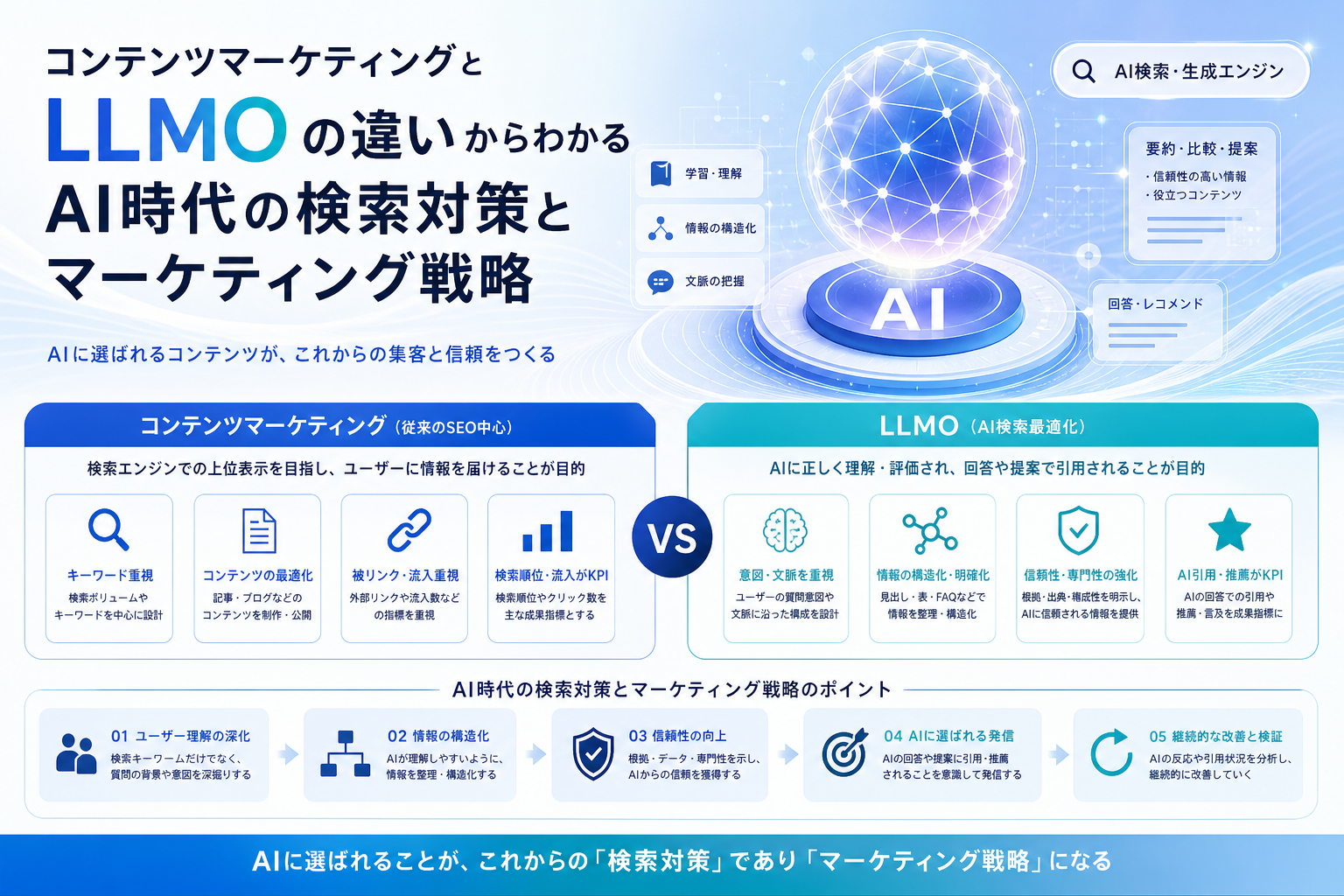
Content marketing focuses on "building trust through solving user challenges," while LLMO is about "optimization to be cited as a primary information source in AI responses," clearly distinguishing whether the optimization target is human or AI.
- Content Marketing: Delivering value to human readers, aiming for long-term trust and customer development
- LLMO: Designed to be cited in generative AI responses such as ChatGPT, Gemini, Perplexity, and AI Overview
Definition of Content Marketing
Content marketing is a method aimed at building long-term trust and customer development through providing valuable information that meets user search intent. It is characterized by breaking away from dependency on advertising and creating a sustainable customer acquisition foundation.
Basic Definition of LLMO
LLMO is a strategy that encourages the citation and recommendation of company information as a "reliable primary information source" in responses generated by large language models. The evaluation axis is not about competing for clicks but about being referenced and cited by AI.
Clarifying the Differences Between LLMO, AIO, GEO, and AEO
Due to the presence of several similar terms that can cause confusion, we will clarify three main concepts.
| Term | Main Target | Purpose |
|---|---|---|
| LLMO | Large Language Models | Citation and recommendation in AI responses |
| AIO | AI Search (AI Overview, etc.) | Information reflection in AI summaries |
| AEO/GEO | Conversational AI and generative engines as a whole | Visualization in response engines |
Why is it necessary to understand these differences now?
As "zero-click" phenomena advance due to AI search, there are cases where even ranking first in search results does not lead to increased access, making it essential to understand the division of roles between content and LLMO.
- Increasing cases where AI presents summarized answers in search results without being clicked
- The evaluation axis is shifting from "clicks" to "references and citations"
Zero-Click and Changes in User Behavior
Users are increasingly satisfied with AI's summarized answers and tend not to transition to sites. This structural change has been pointed out as a reason why traditional SEO focused on rankings is struggling to achieve results.
Reasons Why Content is the Foundation
AI prioritizes learning and citing "beneficial and trustworthy information for humans." If the foundational content is weak, it is said to be less likely to be cited even with technical LLMO measures.
Where should you start?
In conclusion, it is recommended to first tackle "high-quality content marketing," then move to structuring, and finally proceed to brand awareness monitoring in three stages.
| Priority | Initiative | Specific Content |
|---|---|---|
| High | Quality Content Creation (Foundation) | Strengthening primary information, expert articles, and case studies |
| Medium | Site Structuring (LLMO Compliance) | Implementation of Schema.org and clarification of terms and context |
| Low | Brand Awareness on LLMs (Management) | Monitoring self-evaluation in generative AI |
High Priority: Strengthening Primary Information in Content
Create expert articles that solve the deep concerns of your target audience, as well as unique data, interviews, and case studies (primary information). Verifiable primary information is seen as the foundation for AI citations.
Medium Priority: Making the Structure Easily Recognizable by AI
Implement structured data (Schema.org) so that AI can correctly read the information, clearly defining technical terms and brand names within context.
Low Priority: Monitoring Evaluation on LLMs
Regularly check how your brand is evaluated and mentioned on platforms like ChatGPT and Perplexity. Although this is a low priority, continuous observation can serve as a starting point for improvement.
How do the two compare across five axes?
When comparing along the five axes of purpose, target, user behavior, evaluation metrics, and outcome duration, the differences in roles between the two can be clearly organized.
| Comparison Axis | Content Marketing | LLMO |
|---|---|---|
| Purpose | Building trust and customer development | Acquiring citations in AI responses |
| Target | Human readers | Large Language Models |
| User Behavior | Reading, comparing, considering | Referencing AI responses |
| Evaluation Metrics | Traffic, conversion, dwell time | Citation rate, reference rate |
| Outcome Duration | Medium to long term | Medium to long term (pre-investment) |
Differences in Purpose and Approach
Content marketing emphasizes a "passive approach" that responds to search intent, while LLMO focuses on "design philosophy" that allows AI to interpret. Both aim for results through accumulation rather than short-term sales.
Concept of Synergistic Coexistence
Websites that are valued by search engines are also likely to be referenced as reliable sources by AI. Rather than opposing the two, a strategic coexistence aiming for synergy is more realistic.
How to Create Content that is Cited by AI?
To be cited by AI, it is effective to meet four elements: conclusion first, primary information, clear citations, and structured data.
- Write the conclusion first and make it self-contained in 1-2 sentences
- Include verifiable primary information rather than general statements
- Clearly state sources and author profiles as evidence
- Use Q&A formats or Schema to create a structure that is easily recognized by AI
Incorporating Primary Information
Detail survey results and specific success stories. Unique data serves as a differentiating factor from competitors and functions as a basis for AI citations.
Enhancing Q&A and FAQ
Since AI prefers answers in question format, improving FAQ pages is believed to contribute to higher citation rates. It is important to comprehensively cover anticipated questions.
Summary: Where to Start?
Content marketing and LLMO do not oppose each other; rather, they have a relationship where "high-quality content is the foundation, and LLMO is the extension." Therefore, starting with the creation of high-quality content that includes primary information is the optimal solution. By following the three-stage priority (content creation → structuring → brand awareness monitoring), you can build a source of information that will be cited in the AI era. Begin by reviewing existing content from the perspective of "What kind of content do I want to be cited by AI?"
Frequently Asked Questions (FAQ)
Which should be done first, content marketing or LLMO?
You should first start with content marketing (high-quality content creation). Since AI prioritizes citing beneficial and trustworthy information, if the foundational content is weak, it is said to be less likely to be cited even with LLMO measures.
What is the difference between LLMO and SEO?
SEO aims to improve rankings in search engines, while LLMO aims to acquire citations in generative AI responses. A major difference lies in whether the evaluation axis is centered on "clicks" or "references and citations."
What is the difference between LLMO and AIO, GEO, AEO?
LLMO refers to optimization for large language models, AIO refers to optimization for summaries in AI searches, and AEO/GEO refers to optimization for conversational AI and generative engines as a whole. The scope of the target differs.
Can content marketing alone lead to citations by AI?
High-quality content serves as the foundation for citations, but implementing structured data and clarifying terms can make it easier for AI to recognize and cite the information.
Where should small and medium-sized enterprises start?
It is effective to start with primary information that verbalizes repeated misunderstandings or unique experiences in the field. Verifiable unique information becomes a differentiating factor that larger companies do not have.
What are the key points for a structure that is easily cited by AI?
The key is to write with a conclusion-first approach, creating short declarative sentences that are self-contained in 1-2 sentences. Clearly stating sources and utilizing FAQ formats are also believed to support AI citations.