To be selected by AI search (LLMO), labor and social security attorney offices must focus on three types of pages: "Business pages by consultation content," "Office overview and expert profile pages," and "FAQ pages," and it is essential to design information that AI can accurately reference. By structuring and publishing concrete achievements, such as 50 companies introduced for creating employment regulations and 120 case studies for unpaid overtime measures, the likelihood of being referenced by AI significantly increases.
What is LLMO Strategy for Labor and Social Security Attorney Offices?
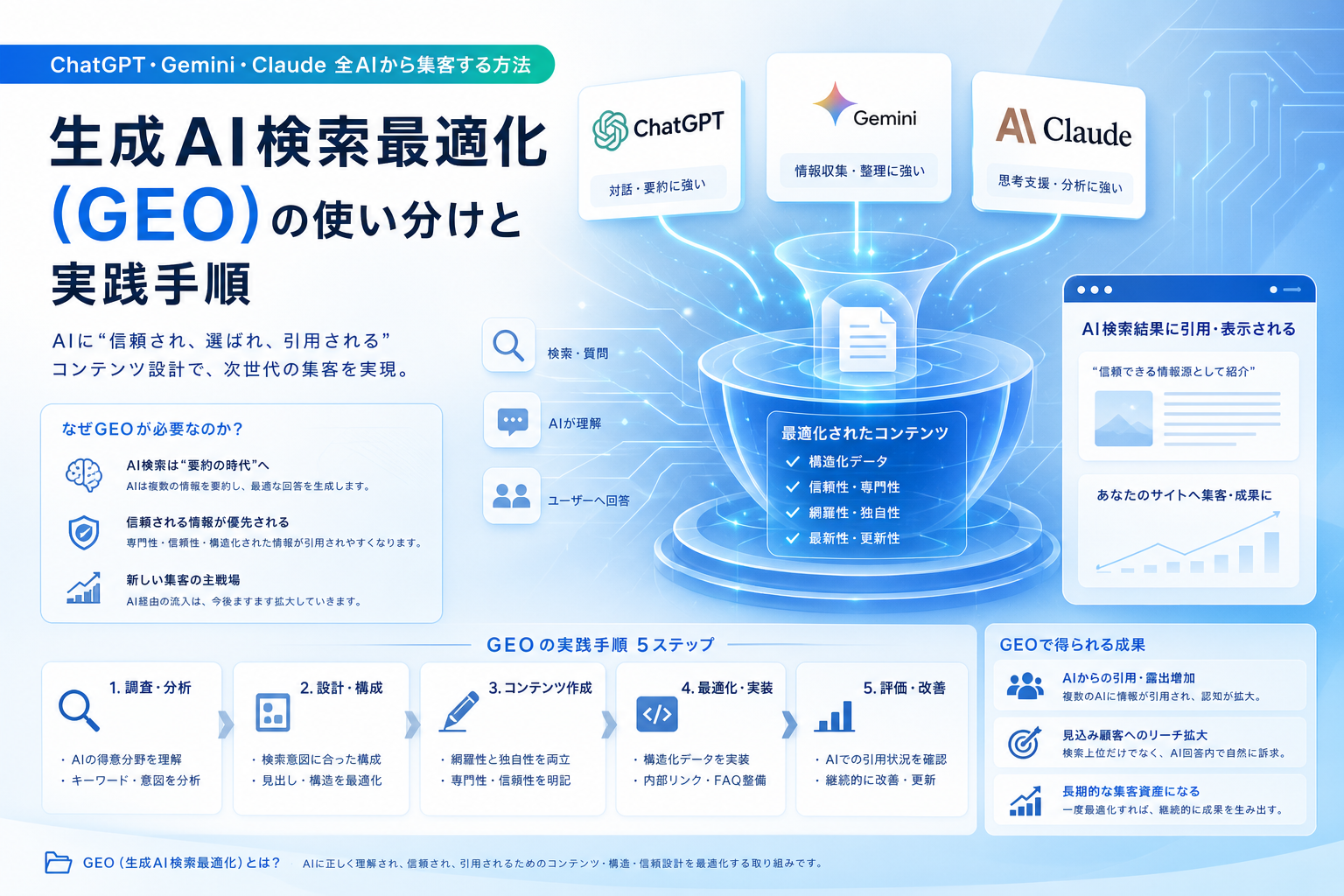
LLMO (Large Language Model Optimization) is a strategy to optimize a company's website so that it is selected when generative AIs like ChatGPT and Google AI Overview reference or recommend information.
While traditional SEO aims for "high visibility in search results," LLMO aims for the goal of being "cited in AI responses."
In the case of labor and social security attorney offices, there is a rapid increase in cases where clients ask AI questions like "What is the application method for subsidies?" or "When is an employment regulation required?"
At this time, the structured expert information on the office's website is what AI references as the basis for its answers.
Understanding the differences and strategies of LLMO, AIO, and GEO, let's proceed with the most suitable strategies for labor and social security attorney offices.
Differences Between LLMO and SEO
There are clear differences between SEO and LLMO as follows:
| Item | SEO | LLMO |
|---|---|---|
| Purpose | High visibility in search results | Cited in AI responses |
| Evaluation Criteria | Authority of the entire page | Accuracy and conciseness at the paragraph level |
| Key Indicators | Number of backlinks, domain power | E-E-A-T, structured data, primary information |
| Content Format | Long-form comprehensive | One paragraph, one topic completion |
In LLMO, it is emphasized that a single paragraph should be self-contained within 60 to 140 characters.
This is because AI tends to quote already completed short sentences rather than extracting key points from long texts.
Three Reasons Why Labor and Social Security Attorney Offices Are Well-Suited for LLMO
The field of labor and social security attorney work is highly compatible with LLMO strategies.
- It falls under the YMYL domain: Labor and social insurance are directly related to "money and life," so AI prioritizes quoting reliable expert information.
- Consultation content is specific: Questions and answers, such as "What are the eligibility requirements for subsidies?" and "What is the statute of limitations for unpaid overtime?" have a one-to-one correspondence structure.
- Strong local needs: When AI responds to area-specific searches like "Labor and social security attorney in Chiyoda, Tokyo," sites with clearly stated location information are prioritized.
If the site is operated by a specific labor and social security attorney with registration number 13010001 and 20 years of practical experience, the basis for reliability for AI becomes clear.
Desired State for Labor and Social Security Attorney Offices' LLMO Strategies
The ultimate goal is to reach a state where "when a client asks AI questions related to labor and social security, the information from their own office is cited as an answer."
To achieve this, the following three conditions must be met:
- AI can identify "whose information it is" (enrichment of expert profiles)
- AI can determine "what kind of expert it is" (separation of business-specific pages)
- AI can guide "where to consult" (clear indication of location and contact information)
If the office is located at 1-1-1 Otemachi, Chiyoda, Tokyo, and has a track record since 1995, it can specifically meet these three conditions.
Reasons Labor and Social Security Attorney Offices Should Engage in LLMO Strategies
For labor and social security attorney offices, LLMO strategies are one of the highest priorities for web customer acquisition in 2026.
Changes in Client Search Behavior
As of 2026, many labor managers and business owners are gathering information not only through Google searches but also through AI tools like ChatGPT and Perplexity.
Keywords like "subsidy application method" and "obligation to create employment regulations" are queries that AI directly generates answers for.
If the information from their office is not included in AI's responses, they won't even be considered an option for clients.
As explained in the complete guide to LLMO for B2B companies, AI search strategies in the BtoB domain are urgent.
Professional Services Are YMYL Domains with Strict Reliability Requirements
The information handled by labor and social security attorneys is directly related to YMYL (Your Money or Your Life).
In generating responses in the YMYL domain, AI emphasizes the following elements:
- Qualifications of the author and supervisor
- Registration number and years of practical experience
- Media publication achievements
- Office location and founding year
Having media achievements such as being featured in the Nihon Keizai Shimbun in April 2023 and contributions to Weekly Diamond will work in favor of AI's reliability evaluation.
Increased Risk of Dependence on Portal Sites
Many labor and social security attorney offices rely on attracting clients through professional portal sites and comparison sites.
However, as AI searches become widespread, information from portal sites may be integrated and summarized by AI, risking the obscuring of individual office information.
Accumulating primary information on their own site and building a structure that AI can directly quote will lead to securing a long-term customer acquisition foundation.
Four Reasons Labor and Social Security Attorney Sites Are Hard to Be Selected by AI Searches
Many labor and social security attorney office sites have common issues that make them difficult to be referenced by AI searches.
Business Content Is Too Abstract
Descriptions like "We support overall labor management" cannot be referenced by AI as a basis for answering specific questions.
It is necessary to describe services individually, such as "Creating employment regulations," "Subsidy applications," "Measures for unpaid overtime," and "Labor audits."
Insufficient Expert Profiles
Just the name and qualifications of the representative are insufficient for AI to determine them as a "reliable expert."
It is essential to clearly state the registration number, years of practical experience, media publication history, and any additional qualifications held.
Few Consultation and Resolution Cases
AI tends to refer to actual support cases when presenting "specific solutions."
Clearly state the number of resolution cases, such as 120 cases for unpaid overtime measures, along with the resolution process.
Insufficient or Formal FAQs
FAQs that end with "Please feel free to contact us" have no citation value for AI.
There needs to be a one-to-one structure for questions and answers, such as "What is the statute of limitations for unpaid overtime?" → "Currently, it is 3 years."
Five Pages to Create for Labor and Social Security Attorney Offices' LLMO Strategies
By placing specific numerical values, such as an average subsidy amount of 2 million yen and 50 checklist items for labor audits on each page, the accuracy of AI citations will improve.
Page 1: Business Pages by Consultation Content
Instead of summarizing all services on the top page, create independent pages for each consultation content.
Each page must include the following four elements.
| Element | Content | Example |
|---|---|---|
| Issue | Specific problems faced by clients | "Employment regulations do not comply with legal revisions" |
| Resolution Steps | Flow from consultation to completion | "Hearing → Draft creation → Revisions → Submission" |
| Fee Structure | Retainer fee, success fee, etc. | Creation of employment regulations: Retainer fee of 100,000 yen |
| Support Cases | Number of achievements and duration | 50 companies introduced, duration of 3 months |
Specific examples of creating business-specific pages are as follows:
- Employment Regulation Creation Page: Clearly state a retainer fee of 100,000 yen, duration of 3 months, and achievements of 50 companies.
- Subsidy Application Page: State a success fee of 15% and an average subsidy amount of 2 million yen.
- Unpaid Overtime Measures Page: Present 120 resolution cases and an average resolution time of 45 days from consultation to resolution.
- Labor Audit Page: Include 50 checklist items and a consulting achievement rate of 98%.
Page 2: Office Overview and Representative Profile Page
A profile page that comprehensively lists registration number 13010001, 20 years of practical experience, and qualifications as a specific labor and social security attorney and industrial counselor will serve as the basis for AI's reliability evaluation.
The essential items to include are the following eight points:
- Representative's name and photo
- Labor and social security attorney registration number (13010001)
- Qualifications held (specific labor and social security attorney, industrial counselor)
- Years of practical experience (20 years)
- Media publication achievements (Nihon Keizai Shimbun April 2023, contributions to Weekly Diamond)
- Office location (1-1-1 Otemachi, Chiyoda, Tokyo)
- Year of establishment (1995)
- Specialty areas and service areas
By consolidating this information on one page, AI can more easily determine that "this expert is reliable."
Page 3: FAQ Page
On the FAQ page, set the questions in the same format that users would ask AI.
Three effective conditions for FAQs are:
- The question is in natural spoken language.
- The answer is concise, consisting of 1-2 sentences.
- The answer includes specific numbers.
Below are examples of FAQs that should be created for labor and social security attorney offices.
| Question | Answer |
|---|---|
| How many months does it take from application to receiving a subsidy? | Usually 4-6 months. |
| What are the costs for resolving disputes with employees? | Initial consultation starts from 10,000 yen for 1 hour. |
| Is it mandatory to revise employment regulations? | It is mandatory for businesses with 10 or more employees. |
| What is the statute of limitations for unpaid overtime? | Currently, it is 3 years. |
Page 4: Regional Pages
If the office is located at 1-1-1 Otemachi, Chiyoda, Tokyo, create pages that correspond to regional keywords such as "Labor and social security attorney in Chiyoda" and "Labor consultation around Otemachi."
The information to include on regional pages is as follows:
- Office location and access methods
- Range of service areas
- Number of support achievements within the region
- Region-specific subsidy and system information
Since AI often generates answers based on the combination of "region name + business name," clearly stating regional information is extremely important.
Page 5: Fee Page
Fee information is one of the most frequently asked topics by clients when they ask AI.
A fee page that clearly states specific numbers, such as a success fee of 15% for subsidy applications and a retainer fee of 100,000 yen for creating employment regulations, will be targeted for AI citations.
The three principles to follow on the fee page are:
- Clarity: Present a baseline amount in numbers instead of "to be discussed."
- Comparability: Separate fees by service and list them in a table.
- Clear Conditions: Clearly distinguish between retainer fees, success fees, and monthly advisory fees.
| Service | Fee Structure | Achievements |
|---|---|---|
| Creation of Employment Regulations | Retainer fee of 100,000 yen | 50 companies introduced |
| Subsidy Application | Success fee of 15% | Average subsidy amount of 2 million yen |
| Unpaid Overtime Measures | Individual estimate | 120 resolution cases |
| Labor Audit | Individual estimate | Improvement rate of 98% |
Article Themes to Create for Labor and Social Security Attorney Offices' LLMO Strategies
In addition to business-specific pages, it is important to continuously publish articles on themes that clients can easily ask AI about.
Based on the priority and strategy for LLMO measures by industry, let's select article themes suitable for labor and social security attorney offices.
Question-Type Themes Clients Search For
AI is more likely to generate answers for specific question-type themes like the following:
- "Types of subsidies and application conditions"
- "List of items to be included in employment regulations"
- "Procedures for dismissing employees"
- "Conditions for joining social insurance and application methods"
- "Obligation to report 36 agreements and penalties"
For each theme, create an article structured as question → answer → flow of procedures → points to note.
Comparison and Selection Themes
Themes like "Differences between labor and social security attorneys and tax accountants," "How to choose an advisory labor and social security attorney," and "Market rates for hiring labor and social security attorneys" are also likely to be referenced by AI.
In these articles, including the office's achievements (120 resolution cases, 50 companies introduced, etc.) as a comparison axis can help differentiate them.
Legal Revisions and System Changes Themes
News articles about legal revisions and system changes in 2026 are highly likely to be cited by AI as the latest information.
However, for frequently updated information, avoid definitive statements and use non-definitive expressions like "As of now, it is said that..."
Introduction of Structured Data and Technical Aspects of AI Search Strategies
Implementing structured data (Schema.org) is the technical foundation for AI to accurately understand the information of the office.
Types of Structured Data Needed for Labor and Social Security Attorney Offices
The following five types of structured data should be prioritized for implementation:
- LocalBusiness: Office name, location (1-1-1 Otemachi, Chiyoda, Tokyo), business hours, phone number
- Person: Representative's name, qualifications (specific labor and social security attorney), registration number (13010001)
- FAQPage: Questions and answers for each FAQ item
- Service: Business content, fees, service areas
- Review: Customer evaluations and reviews
Implementation Priority
It is recommended to proceed with the introduction of structured data in the following order:
- Highest Priority: LocalBusiness + Person (basic information about the office and expert)
- Next Priority: FAQPage (direct target for AI citations)
- Thereafter: Service + Review (strengthening business content and reliability)
Also, understand the mechanism of Google search "AI mode" and proceed with technical measures.
LLMO Strategy Checklist for Labor and Social Security Attorney Offices
Similar to the 50 checklist items for labor audits with an improvement rate of 98%, LLMO strategies can be advanced based on a comprehensive checklist to prevent omissions.
Overall Site Checklist Items
- Are services separated into individual pages (at least 4 pages: employment regulations, subsidies, unpaid overtime, labor audits)?
- Is the representative profile listed with the registration number, career, and media achievements?
- Are there at least 6 FAQs installed?
- Is structured data implemented in more than 3 types?
- Is fee information clearly stated in numbers?
Checklist Items for Each Page
- Is each paragraph completed within 300 characters?
- Does each paragraph contain at least one specific number?
- Can the first sentence immediately under the heading be independently quoted as a conclusion?
- Are explanations provided for technical terms?
- Is the last updated date stated?
Operational Checklist Items
- Is content updated at least once a month?
- Is legal revision information reflected within 3 business days?
- Is the citation status in AI searches monitored monthly?
- Is the AI search display status of competing offices checked regularly?
Differences in LLMO Strategies Between Labor and Social Security Attorney Offices and Other Professions
The LLMO strategies for labor and social security attorney offices have different points compared to lawyers, tax accountants, and administrative scriveners.
| Profession | Main Clients | Information Emphasized in AI Searches | Priority of Measures |
|---|---|---|---|
| Labor and Social Security Attorney | Business owners and HR personnel | Subsidies, employment regulations, labor management | Separation of business-specific pages |
| Lawyer | Individuals and businesses | Lawsuits, settlements, legal consultations | Clarification of expertise by field |
| Tax Accountant | Individual business owners and corporations | Tax returns, tax savings, tax audits | Enhancement of fee comparison information |
| Administrative Scrivener | Individuals and corporations | Permit applications and notifications | Visualization of procedural flows |
In the case of labor and social security attorney offices, the obligations and procedures change depending on the size of the business (whether there are 10 or more employees), so organizing information by size is particularly important.
Using the success points for utilizing AI in business as a reference, let's comprehensively build a customer acquisition strategy for the AI era.
Specific Actions for Labor and Social Security Attorney Offices to Be Cited in AI Searches
Advance LLMO strategies step by step with the following five steps.
Step 1: Current Situation Analysis (1 week) Search for "Labor and social security attorney subsidies" and "Creating employment regulations" using ChatGPT, Perplexity, and Google AI Overview to check the citation status of your office.
Step 2: Creation of Business-Specific Pages (2-4 weeks) Create independent pages for at least four services, such as creating employment regulations (retainer fee of 100,000 yen, 50 companies introduced) and subsidy applications (success fee of 15%, average subsidy amount of 2 million yen).
Step 3: Strengthening Profiles and Office Overview (1 week) Comprehensively list registration number 13010001, 20 years of practical experience, and achievements published in the Nihon Keizai Shimbun in April 2023.
Step 4: Implementation of FAQs and Structured Data (2 weeks) Set up more than 6 FAQs and implement structured data for FAQPage, LocalBusiness, and Person.
Step 5: Continuous Content Updates (Monthly) Add articles on legal revision information and new subsidy systems at least once a month, and monitor the citation status in AI searches.
Frequently Asked Questions (FAQ)
How long does it take for labor and social security attorney offices' LLMO strategies to be implemented?
Basic page setup takes about 4-8 weeks, and it typically takes 3-6 months to confirm citations by AI. The initial measures include creating independent pages for the four main services, such as employment regulations and subsidies, and implementing structured data.
Should LLMO strategies and SEO strategies be pursued simultaneously?
It is recommended to pursue them simultaneously. The "one-paragraph completion structure," "enhancement of E-E-A-T," and "structured data" emphasized in LLMO also positively impact SEO. By conducting both strategies in parallel, you can secure exposure in both search results and AI responses.
How many questions should be included on the FAQ page?
At least 6 questions, ideally aiming for 15-20 questions. A structure where questions and answers are one-to-one, such as "How many months does it take from application to receiving a subsidy? Usually 4-6 months," is the most likely to be cited by AI.
Can structured data be implemented by myself?
If in JSON-LD format, it can be implemented simply by adding the code within the HTML `` tag. The two types, LocalBusiness (office information) and FAQPage (frequently asked questions), can be handled using templates without specialized knowledge.
Is LLMO strategy necessary for small labor and social security attorney offices?
Yes, it is necessary. In fact, the effectiveness is even greater for smaller offices. By publishing concrete achievement data, such as 120 resolution cases for unpaid overtime measures and a 98% improvement rate for labor audits, AI will evaluate them as citation targets regardless of the size of the office.
What is the most important page for labor and social security attorney offices' LLMO strategies?
The office overview and representative profile page. Since AI prioritizes the reliability of information in the YMYL domain, consolidating the registration number 13010001, 20 years of practical experience, qualifications as a specific labor and social security attorney and industrial counselor, and achievements published in the Nihon Keizai Shimbun and Diamond onto one page is the most crucial.
Conclusion: Key Factors for Labor and Social Security Attorney Offices to Be Selected in AI Searches
In the LLMO strategies for labor and social security attorney offices, separating and publishing concrete achievements, such as creating employment regulations (retainer fee of 100,000 yen, 50 companies introduced), subsidy applications (success fee of 15%, average subsidy amount of 2 million yen), unpaid overtime measures (120 resolution cases, resolved in an average of 45 days), and labor audits (50 checklist items, 98% improvement rate) on business-specific pages, and consolidating information like registration number 13010001, 20 years of practical experience, and achievements published in the Nihon Keizai Shimbun in April 2023 on the profile page is the shortest route for AI to cite them as "reliable experts."