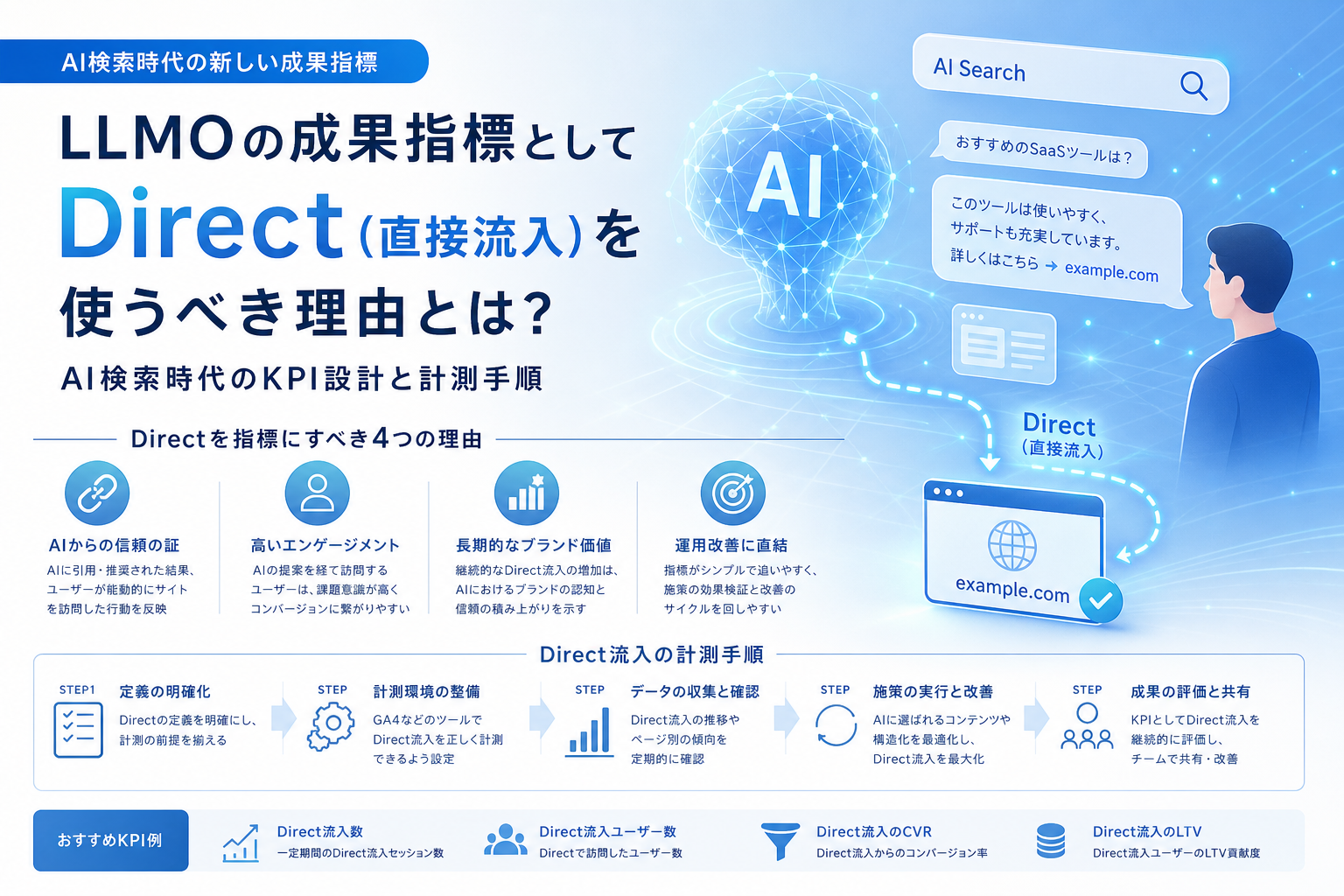
The reason why Direct (direct traffic) should be used as a performance indicator for LLMO is that traffic from AI applications and browser extensions like ChatGPT lacks referral information and is measured as "Direct." When users click on links from AI search results, the referrer is missing, so the increase in Direct traffic serves as a proxy indicator reflecting results through AI. However, since Direct also includes bookmarks and direct URL entries, analysis combining branded searches and AI referrers is essential.
Why is Direct traffic a performance indicator for LLMO?
Much of the traffic from AI searches is classified as "Direct" due to the lack of referrer information. This is the primary reason for using Direct as a proxy indicator for LLMO.
- Transitions from the in-app browser of the ChatGPT mobile app often do not carry over the referrer
- Some AI platforms lose the referrer during transitions from HTTPS to HTTP
- Clicks via browser extensions often lack a referrer
In other words, as AI citations increase, Direct traffic also tends to increase, making it an effective observation point.
What is the mechanism behind the surge in "Direct" in GA4?
In GA4, "direct / none" is a specification that classifies not only true direct traffic but also traffic with missing referrer information together.
The main reasons why AI traffic mixes with Direct are as follows:
- Loss of referrer due to in-app browsers
- Referrer loss due to SSL settings or transition specifications
- Mixing with direct URL entries and bookmarks
Therefore, when observing a surge in Direct, it is necessary to differentiate between "potential AI effects" and "technical factors." If viewed alongside changes in CTR, the analysis methods for CTR decline due to AI searches can also be helpful.
Why is Direct alone insufficient?
Direct traffic alone cannot accurately measure the performance of LLMO. This is because Direct encompasses multiple sources of traffic.
The main elements included in Direct are as follows:
- Traffic with missing referrer due to AI (potential AI effects)
- Revisits from bookmarks
- Direct URL entries
- Transitions from email apps or native apps
For this reason, changes in Direct should merely serve as "observation triggers," and it is recommended to support them with multiple indicators.
Three indicators to combine with Direct
The performance from AI should be evaluated using a set of three indicators: Direct, AI referrer, and branded searches. Using only one indicator can easily lead to misinterpretation of causality.
1. Identification of AI referrers
Extract referral traffic from specific domains like chatgpt.com and perplexity.ai in GA4. Traffic that can be measured without mixing with Direct serves as definitive evidence of AI effects.
2. Increase in branded searches
Track the number of searches for company names and service names in Google Search Console. When AI mentions increase awareness, there tends to be a rise in branded searches.
3. Number of AI brand mentions
Record whether your company is actually mentioned or recommended in responses from ChatGPT, Gemini, Perplexity, etc. Using the method to check your company's citation status in AI searches can make it easier to conduct fixed-point observations.
How should Direct traffic be analyzed and broken down?
Direct traffic should be broken down into "AI-induced," "revisits," and "technical factors" as a basic procedure. Following only the increase or decrease without breakdown can lead to incorrect conclusions.
The steps for analysis are as follows:
- Check the overall trend of Direct on a monthly basis
- Look at the new user ratio to infer whether it is a first visit or a revisit
- Confirm the correlation with the trend of AI referrer traffic
- Overlay the trend of branded searches over time
- Check landing pages to infer whether it is via bookmarks or AI guidance
A high new user ratio in Direct is likely indicative of initial traffic via AI.
What are the pitfalls in measurement other than Direct?
The numbers for Direct can increase due to technical deficiencies, so checking the health of the measurement environment is essential. Neglecting this can lead to overestimating AI effects.
Technical factors that can mix into "direct / none" include:
- Transitions from non-SSL compliant pages
- Tag not firing due to delays in display speed
- Referrer spam or bot traffic
- Implementation omissions of measurement tags
It is important to differentiate between unavoidable factors (direct input, bookmarks, opt-outs) and factors that can be addressed (SSL, speed, spam). For implementation checks, the LLMO countermeasure diagnostic checklist can be helpful.
Example of KPI design for LLMO performance indicators (2026 version)
As of 2026, measuring LLMO effects involves designing multiple KPIs that combine quantitative and qualitative aspects. Rather than relying solely on Direct, it is essential to set target values and track them over time.
| Indicator | Measurement Tool | Role | Example of Target Setting |
|---|---|---|---|
| Direct (direct traffic) | GA4 | Observation point for AI effects | Track the increase in new Direct ratio |
| AI referrer traffic | GA4 (Referral) | Confirmatory data for AI | Extract major 4 platforms |
| Number of branded searches | Search Console | Brand lift | Confirm increase in branded searches over 3 months |
| AI mention rate | Manual survey | Understanding mention frequency | Fixed-point observation with a question list |
| Sentiment | Manual survey | Evaluate the quality of mentions | Classify as positive, neutral, or negative |
If you are aligning evaluation axes in the B2B domain, please refer to the Complete Guide to LLMO for B2B Companies.
What are the limitations and risks of manual measurement?
Manual measurement of AI mentions faces two barriers: reproducibility and personalization. Failing to understand these can lead to incorrect decision-making.
The main limitations of manual measurement are as follows:
- Personalization causes responses to vary by person and environment
- The output varies each time even for the same question, leading to low reproducibility
- Bias can easily enter into the selection of the question list
- High labor intensity makes it difficult to sustain
For this reason, it is recommended to fix operational rules through methods like screenshot recording to improve the accuracy of fixed-point observations.
Frequently Asked Questions (FAQ)
Can we definitely say that an increase in Direct traffic is due to AI effects?
It cannot be said for certain. Direct includes bookmarks, direct URL entries, and technical referrer losses. It is recommended to confirm alongside increases in AI referrer traffic and branded searches over time.
Is there a way to distinguish AI-related traffic in GA4?
There is a method to extract referral traffic from specific domains like chatgpt.com, perplexity.ai, and gemini.google.com. However, traffic via in-app browsers tends to mix with Direct, so the referral capture may only represent a portion of AI traffic. For site-side improvement measures, refer to site improvement measures to be cited in AI searches.
Is it acceptable to report LLMO performance using only Direct?
Reporting solely on Direct is not recommended. Direct should be used as an observation trigger, and a comprehensive evaluation combining AI referrer, branded searches, and AI mention rates will lead to more accurate performance reporting.
How do you differentiate between branded searches and Direct?
Branded searches capture changes in awareness in Search Console, while Direct captures actual visit behavior in GA4. When AI mentions increase awareness, branded searches tend to rise, followed by increases in Direct and revisits, making it a coherent interpretation.
Conclusion: Visualizing LLMO performance through multiple indicators starting from Direct
The reason Direct (direct traffic) is emphasized as a performance indicator for LLMO is that traffic from AI applications and extensions is classified as Direct due to the lack of referrer information. However, since Direct also includes bookmarks, direct URL entries, and technical deficiencies, it is essential to evaluate it in combination with AI referrer traffic, branded search numbers, and AI mention rates for accurate measurement. As of 2026, using Direct as a starting point for observation while analyzing multiple KPIs over time is considered a practical method for visualizing LLMO performance.
This article explains general concepts of web analytics and LLMO measurement. Please note that specifications for GA4 and Search Console may be updated, so be sure to check the latest official documentation as well.