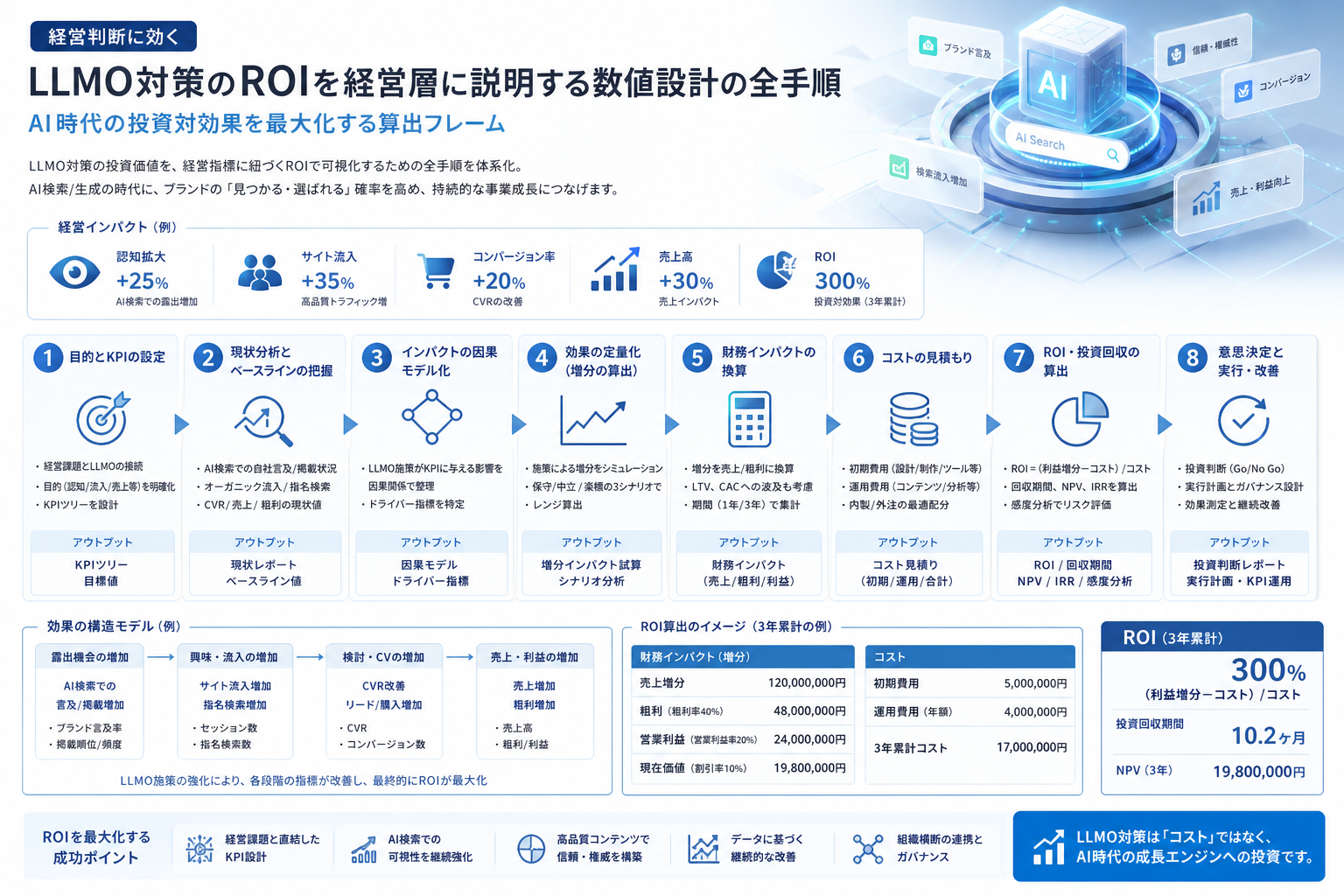
The ROI for LLMO measures is calculated as "Profit from brand lift and increased direct searches via AI" ÷ "Investment amount" × 100. Unlike traditional SEO, quantifying indirect conversions through citations and recommendations in AI response engines, in addition to direct traffic, is key to convincing management. Presenting three scenarios: conservative, realistic, and optimistic, along with the payback period, can increase the likelihood of obtaining approval.
What is the ROI for LLMO measures? An overview of the numerical design necessary for explaining to management
The ROI for LLMO measures is an indicator that shows how much profit was gained relative to the costs invested in AI search optimization. A unique numerical design is required for calculation.
In a nutshell, the ROI for LLMO measures is "how much outcome was achieved relative to the investment cost"
ROI is a universal metric calculated as "(Profit − Investment amount) ÷ Investment amount × 100". In LLMO measures, it is characterized by including indirect effects via AI in the profit calculation.
Why is it necessary to calculate the ROI for LLMO measures now?
With the spread of AI response engines, search behavior is shifting from "click-based" to "answer-complete". Therefore, a new numerical design is required, as traditional click counts alone cannot capture the results.
Reasons why management requests explanations for ROI calculations
Management focuses on the difference between "revenue" and "cost", as well as the likelihood of that difference. Since the effects of LLMO are not easily visible, logical quantification is considered a prerequisite for approval.
Basic calculation formula for ROI that you should know first
The ROI for LLMO measures is calculated as "ROI(%) = (Profit from LLMO measures − Investment amount) ÷ Investment amount × 100". It is generally considered standard to add indirect effects via AI to the profit.
ROI calculation formula (simple formula)
- ROI(%) = (Profit − Investment amount) ÷ Investment amount × 100
- Profit = Number of visits via AI × Average CVR × Customer unit price
- Add the assist effect of increased direct searches
Example of ROI calculation (understanding with specific numbers)
With an investment amount of 1 million yen, 2,000 visits via AI, a CVR of 3%, and a customer unit price of 50,000 yen, the profit is 2,000×0.03×50,000 yen = 3 million yen. The ROI is (300−100)÷100×100 = 200%.
Differences from metrics that are easily confused with ROI
- ROAS: The ratio of revenue to advertising costs
- CPA: The cost per conversion
- LTV: Customer lifetime value
- ROI is different from other metrics in that it is profit-based
Reasons why calculating the ROI for LLMO measures is difficult
The main reasons why calculating the ROI for LLMO measures is difficult are considered to be "time lag in results", "difficulty in measuring inflows", and "invisibility of indirect effects".
It takes time for results to show up in numbers
There may be a time lag of several months before the learning and citation of LLM stabilizes. It is recommended not to judge based solely on short-term ROI.
It is difficult to accurately measure inflows from AI searches
Inflows from AI response engines tend to leave few referrers, making measurement accuracy a challenge. Using the increase in direct searches as a substitute metric is common practice.
Indirect effects (such as brand awareness) are hard to see
Recommendations made by AI enhance brand awareness, but quantifying this is difficult. An approach that visualizes changes through before-and-after comparisons of direct search numbers is used.
Traditional SEO metrics and LLMO metrics are different
SEO focuses on search rankings and click counts, while LLMO is thought to center around metrics such as citation rates and recommendation rates.
How to choose metrics for calculating the ROI for LLMO measures
When calculating the ROI for LLMO measures, it is a top priority to select KPIs that are directly connected to business impact and are easy for management to understand.
Choosing metrics that are easy for management to understand is the top priority
Metrics that can be converted into revenue, profit, and cost reductions are prioritized over rankings and impressions. It is important to translate technical terms into a common language within the organization.
List of key KPIs that can be used for LLMO measures
- AI citation rate: The percentage of references to the company by major AI engines
- Brand recommendation rate: The frequency with which AI recommends the company
- Number of direct searches: The search volume for the brand name
- AI conversion rate: The conversion rate of users coming from AI
- Payback period: The number of months until investment recovery
Approaches to quantifying difficult-to-measure metrics
Indirect effects can be converted into monetary value by multiplying the increase in direct searches by the average CVR and customer unit price. This is thought to allow for the quantification of qualitative awareness effects.
ROI calculation formula and calculation steps for LLMO measures
The ROI for LLMO measures is designed in four steps: "Identifying investment costs → Defining profits → Calculating ROI → Calculating payback period".
Step 1: Identify investment costs
- Costs for strategy design and consulting
- Labor costs for content creation and modification
- Costs for tool implementation and operation
- Sum these monthly to finalize the investment amount
Step 2: Define the profits (returns) obtained
Profits are defined by adding the assist effect of increased direct searches to the direct conversion amount via AI. It is also recommended to include cost savings from advertising cost substitutions as profit.
Step 3: Calculate ROI and payback period
After calculating ROI(%), calculate the payback period by dividing the investment amount by monthly profit. Including the payback period is said to enhance management's sense of assurance.
How to create numbers to gain approval in management meetings
In management meetings, presenting three scenarios: conservative, realistic, and optimistic, and including hedged numbers is considered key to obtaining approval.
Presenting numbers with three scenarios
| Scenario | AI conversion rate | Monthly profit | Payback period |
|---|---|---|---|
| Conservative | 1.5% | 1.5 million yen | 8 months |
| Realistic | 3.0% | 3 million yen | 4 months |
| Optimistic | 5.0% | 5 million yen | 2 months |
*The above is an example of calculation, and actual numbers may vary based on each company's assumptions.
Emphasizing the quality of prospective customers (LTV)
Users who come via AI searches tend to have clearer challenges, resulting in higher CVR and LTV compared to regular searches. Demonstrating quality with data is effective.
Presenting the perspective of advertising cost substitution (CPA reduction)
Show how much advertising costs (CPA) can be substituted or reduced by AI recommending the company. The perspective of cost-cutting is a highly relevant point of interest for management.
Specific KPIs and measurement indicators that convince management
In LLMO measures, it is important to monitor KPIs that are directly linked to business impact rather than rankings.
Key indicators to monitor
- Baseline and trends of AI citation frequency
- Year-on-year comparison of direct search numbers
- Conversion rate and LTV of inflows via AI
- Actual values of the payback period
Reasons to start with baseline visualization
By visualizing citation frequency and direct searches before the measures, changes after the measures can be quantitatively evaluated. Understanding the current situation is the starting point for calculating ROI.
Conclusion | Key to explaining the ROI for LLMO measures to management
The ROI for LLMO measures is calculated as "(Profit via AI + Assist effect of increased direct searches − Investment amount) ÷ Investment amount × 100", and presenting three scenarios: conservative, realistic, and optimistic, along with the payback period, is key to convincing management. The first step is to visualize the baseline of citation frequency and direct searches and convert it into KPIs that are directly linked to business impact.
Frequently Asked Questions (FAQ)
How long should it take to calculate the ROI for LLMO measures?
Considering the time lag in results, it is recommended to evaluate over a period of three months or more. Judging based solely on the short term may underestimate indirect effects.
What is the difference between the ROI for LLMO measures and the ROI for SEO?
SEO focuses on click counts, while LLMO includes AI citation rates and increases in direct searches in its calculations. Quantifying indirect conversions is key.
What should I do if inflows via AI are difficult to measure?
It is common to use the increase in direct search numbers as a substitute metric. Comparing before and after searches converts indirect effects into monetary value.
What should I present to convince management?
It is effective to present three scenarios: conservative, realistic, and optimistic, along with the payback period. Including hedged numbers is important.
What KPIs should be prioritized in LLMO measures?
Key KPIs include AI citation rate, brand recommendation rate, number of direct searches, AI conversion rate, and payback period. Choose metrics that are directly linked to business impact.
Where should I start when calculating the ROI for LLMO measures?
Start by visualizing the baseline of citation frequency and direct searches. The next steps will be identifying investment costs and defining profits.
How do I quantify indirect effects (brand awareness)?
Convert the increase in direct searches into monetary value by multiplying it by the average CVR and customer unit price. This is thought to allow for the inclusion of qualitative awareness effects as profit.
About this article: This article organizes general information regarding the calculation of ROI for LLMO (Large Language Model Optimization) measures based on publicly known frameworks and formulas. The numerical examples provided are intended for understanding calculations and do not guarantee actual effects. Please adjust specific estimates according to each company's assumptions.