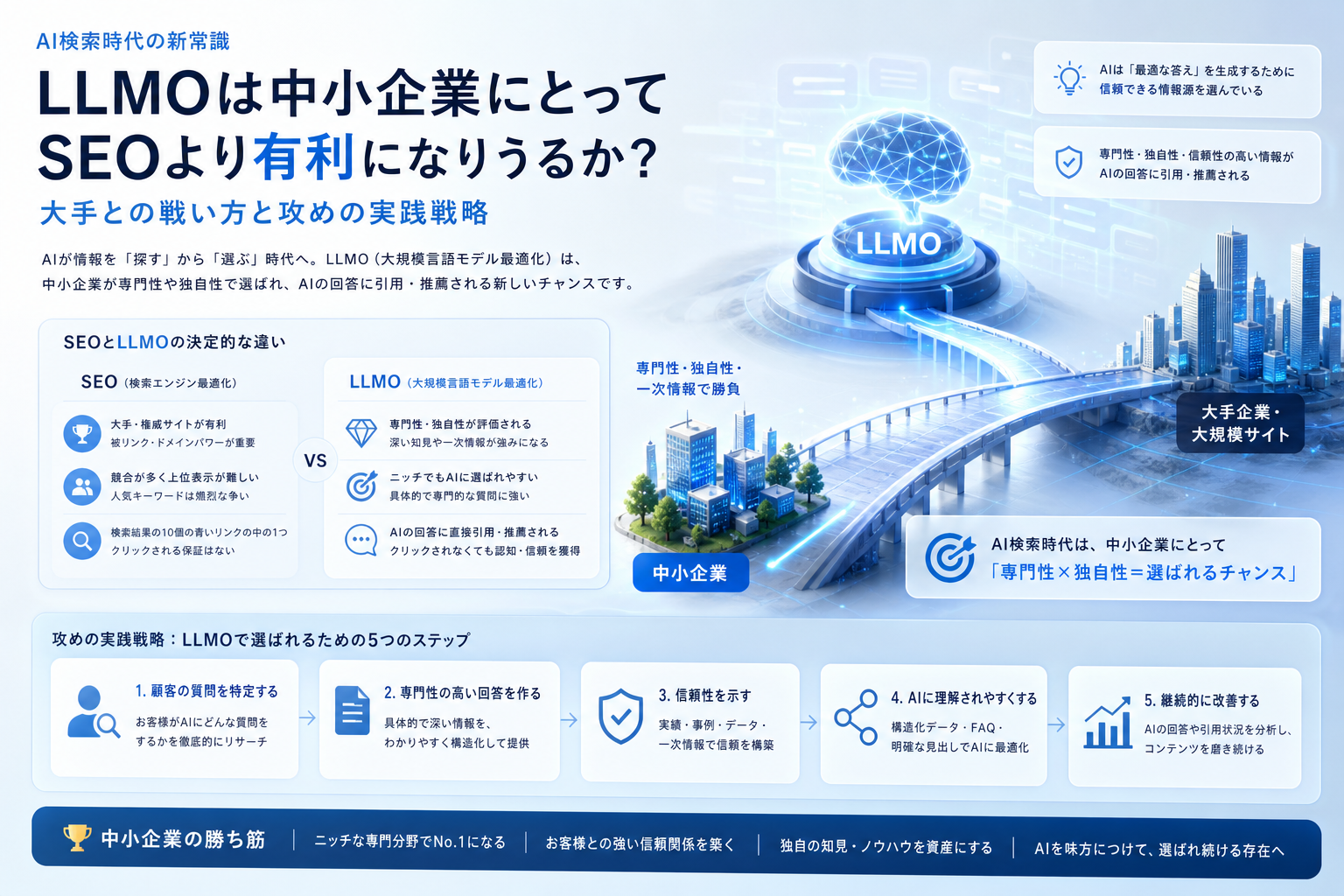
LLMO (Large Language Model Optimization) is a method of attracting customers that can be advantageous for small and medium-sized enterprises depending on their strategy, more so than traditional SEO. Unlike SEO, where large companies dominate advertising space due to their financial power, LLMO is determined by AI selecting information as "trustworthy sources." With niche expertise and E-E-A-T, it is believed that small and medium-sized enterprises with limited budgets can compete on the same level as large companies. This article organizes the reasons and specific strategies for this.
What is LLMO? Definitions Small and Medium-sized Enterprises Should Understand
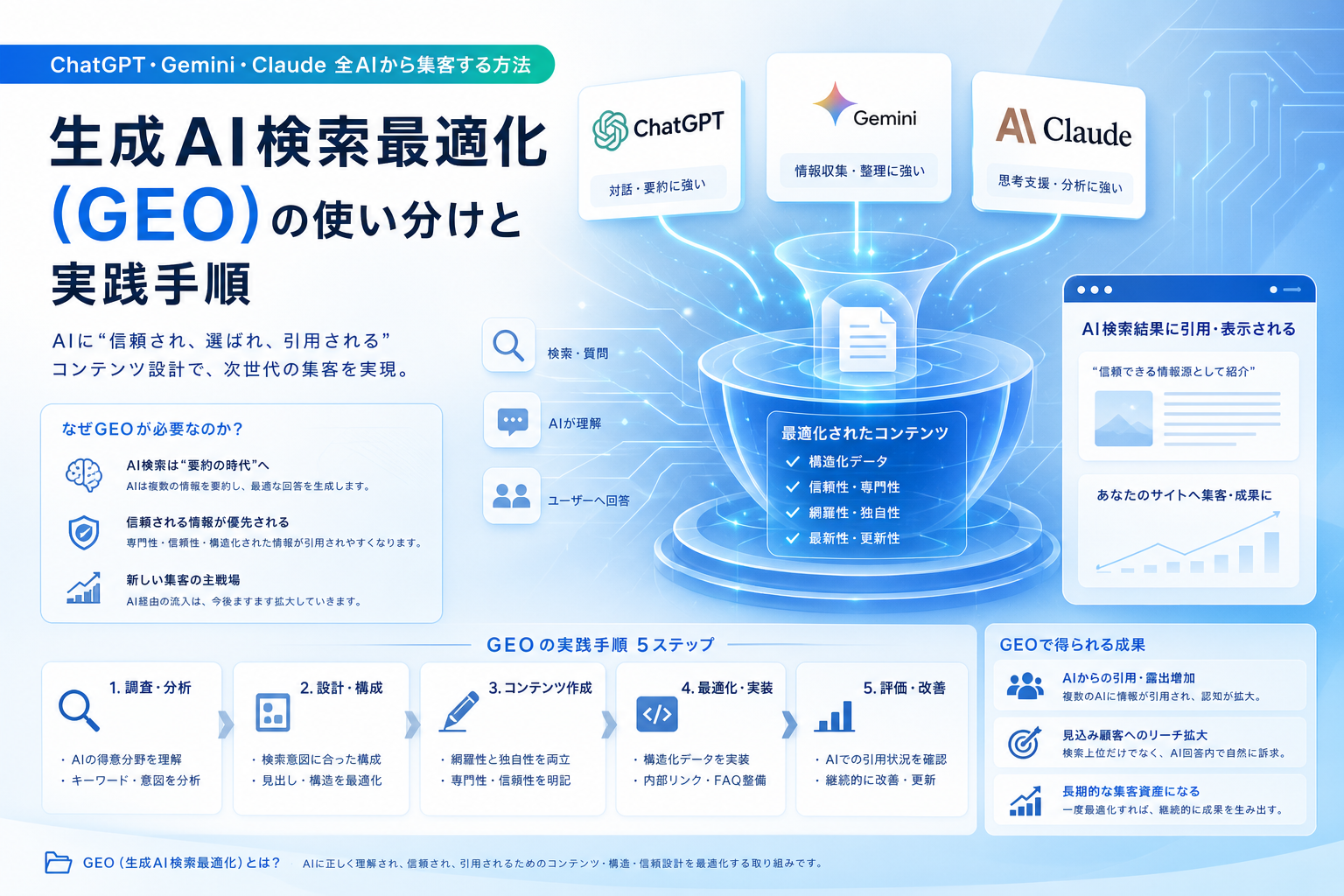
LLMO is an optimization method that makes it easier for generative AIs like ChatGPT and Google AI Overview to reference and cite a company's content when generating answers.
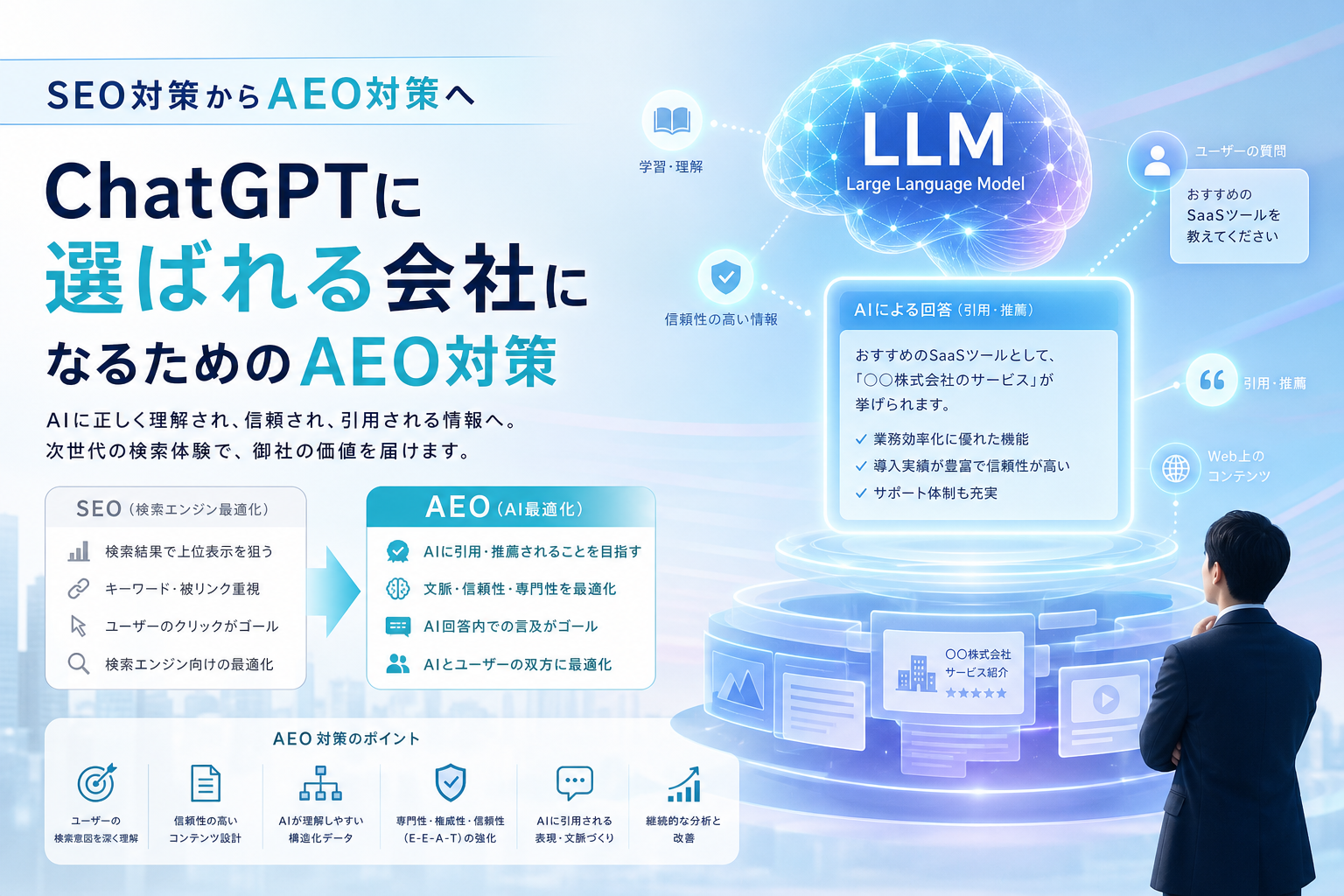
While traditional SEO competes for "search rankings," LLMO aims for "citations and mentions within AI responses." Since the evaluation axis is reliability rather than ranking, the approach fundamentally changes.
- SEO: The goal is to rank high in search results
- LLMO: The goal is to be cited in AI responses
- Commonality: The importance of E-E-A-T (Experience, Expertise, Authority, Trustworthiness)
By organizing the differences and practical measures of LLMO, AIO, and GEO, you can prevent confusion over terminology.
Why Can LLMO Be Advantageous for Small and Medium-sized Enterprises?
LLMO is evaluated based on expertise and reliability rather than "big companies = correct," which may work to the advantage of small and medium-sized enterprises with niche areas.
AI emphasizes comprehensive reliability of information. Therefore, information from small and medium-sized enterprises with deep experience in specific fields or regions may be prioritized for citation over that from large companies.
The main reasons why LLMO can be advantageous for small and medium-sized enterprises are as follows:
- AI values "who wrote it and what experience they have," making it easier for businesses with real experiences to be evaluated positively
- There are many free initiatives like structured data and Q&A that can be undertaken
- Clarity of answers and primary information are more important than the quantity of articles or the number of backlinks
What Are the Differences Between SEO and LLMO?
SEO is optimized for search engines, while LLMO is optimized for AI, with different purposes, targets, and evaluation metrics.
They are not in opposition but rather in a complementary relationship. The foundation of high-quality content cultivated through SEO serves as the basis for LLMO.
| Comparison Axis | SEO | LLMO |
|---|---|---|
| Purpose | High ranking in search results | Citations and mentions in AI responses |
| Target | Search engines | Generative AI and large language models |
| Evaluation Metrics | Ranking, clicks, traffic | Citation count, mentions, brand recall |
| Commonality | E-E-A-T and high-quality content | E-E-A-T and high-quality content |
What Are the Basic Strategies for Competing with Large Companies Using LLMO?
The basics for small and medium-sized enterprises to compete with large companies are the two axes of "niche specialization" and "visualization of E-E-A-T."
While large companies compete on comprehensiveness, small and medium-sized enterprises compete on depth. Deep answers focused on specific problems, regions, or industries are the content that AI will want to cite.
- Create deep answers for specific regions and niches that large companies cannot provide
- Prepare clear answers in a Q&A format that AI can easily cite
- Clearly state real experiences (Experience) and expertise (Expertise)
The priority by industry can be checked in LLMO strategy priorities and industry-specific strategies.
How to Create Niche and Specialized Content?
Niche specialized content becomes easier for AI to cite by focusing on "one page, one topic."
It is effective to avoid being greedy with themes and to structure articles to answer one question completely. AI tends to cite articles that provide clear answers rather than vague ones.
- Place a definition and summary at the beginning of the article
- Include keywords in headings and clarify the section structure
- Use bullet points and tables actively
- Clearly state facts and sources
How to Visualize E-E-A-T (Expertise and Trustworthiness)?
Visualizing E-E-A-T starts with clearly stating the author's real experiences and professional qualifications and achievements.
AI selects "trustworthy information sources." Articles written by experts based on their experiences are considered more likely to be cited than those with unknown authors.
- Clearly state expertise, achievements, and background in the author profile
- Incorporate primary information (company data, original research)
- Implement structured data (such as FAQPage schema)
- Acquire citations (mentions from other sites)
What Are the Technical Measures to Gain AI Trust?
The basics of technical measures are the implementation of structured data and the installation of llms.txt.
Creating an environment where AI can correctly read and understand your website is a prerequisite. If the technical aspect is weak, even good content may be less likely to be cited.
- Install llms.txt to make it easier for AI to read the site
- Implement structured data like FAQPage and Article
- Organize heading hierarchies to enhance machine readability
- Ensure regular information dissemination to maintain freshness
Implementation in the B2B sector can refer to The Complete Guide to LLMO for B2B Companies.
When Should Small and Medium-sized Enterprises Start Working on LLMO?
LLMO is particularly valuable for small and medium-sized enterprises that can aim for the top in specific regions or niche fields to start working on it early.
However, if there is no foundation in SEO, it is essential to solidify traditional SEO measures first. Since LLMO is an extension of SEO, skipping the foundational work can make it difficult to see results.
- Minimum requirement: Businesses that can aim for the top in niche fields
- SEO foundation is the top priority: If web marketing has not been started
- Ideal is to balance: Enhance existing SEO while adding AI optimization
The overall picture of AI utilization in 2026 can be understood in AI Utilization Methods to Implement in 2026.
How to Measure the Results of LLMO?
The results of LLMO are measured not by "search rankings" but by "the presence or absence of citations and mentions in AI responses."
Since the effects are not easily visible with just click numbers, it is necessary to add indicators such as traffic from AI and brand recall.
- Check for mentions of your company in ChatGPT, Gemini, and AI Overview
- Measure traffic from AI
- Track changes in direct searches for the brand name
- Monitor whether your company is included in the sources of cited answers
What Are the Advantages and Disadvantages of Working on LLMO?
The biggest advantage of LLMO is the ability to gain "new E-E-A-T" evaluated by AI without backlinks.
On the other hand, there are disadvantages such as a short history and unclear market and evaluation standards. It is safer to start with a current diagnosis before investing a budget based on excessive expectations.
| Perspective | Content |
|---|---|
| Advantages | Evaluation without backlinks, new traffic through AI, expansion of brand recognition |
| Disadvantages | Unclear market, developing effectiveness measurement, low immediacy |
The changes in the mechanism of Google search are explained in detail in The Mechanism of Google Search "AI Mode".
What Is the Cost Range for LLMO Measures?
The cost for LLMO measures is generally considered to be between 100,000 to 1,000,000 yen for initial diagnosis and over 100,000 yen per month for ongoing consulting.
Due to its short history and unclear market, it is a low-risk approach to first understand the current situation through an initial diagnosis and then proceed to ongoing measures based on the results.
- Initial diagnosis and analysis: 100,000 to 1,000,000 yen (one-time)
- Ongoing consulting: 100,000 yen or more per month
- Content production: 30,000 to 150,000 yen per article (additional)
How to Decide Between In-house and Outsourcing?
LLMO is realistically divided into in-house, outsourcing, or hybrid based on the availability of resources and expertise.
Outsourcing everything can lead to high costs, while doing everything in-house can result in stagnation due to a lack of know-how. Combining the strengths of both options is effective.
- Cases suitable for in-house: There are writing and technical resources within the company
- Cases suitable for outsourcing: Lack of expertise and a desire for early results
- Hybrid model: Outsource strategy while managing operations in-house
Conclusion: The Key for Small and Medium-sized Enterprises to Compete with Large Companies Using LLMO
The key for small and medium-sized enterprises to compete with large companies using LLMO is the three points of niche specialized content, visualization of E-E-A-T, and technical measures that can be started for free, such as structured data.
LLMO is an extension of SEO, and the core is to make AI recognize "this company in this field." Starting with a relatively low investment of 100,000 to 1,000,000 yen for initial diagnosis is considered valuable for small and medium-sized enterprises with limited budgets to begin early.
Frequently Asked Questions (FAQ)
Is LLMO really advantageous for small and medium-sized enterprises?
It is believed to be advantageous depending on the strategy. AI may prioritize citing expertise and real experiences in specific fields over the comprehensiveness of large companies.
Which should be prioritized, LLMO or SEO?
If there is no foundation in SEO, then SEO is the priority. LLMO is an extension of SEO, and the foundation of high-quality content directly benefits LLMO.
How much does LLMO measures cost?
Initial diagnosis is estimated at 100,000 to 1,000,000 yen, and ongoing consulting is generally over 100,000 yen per month. Content production is estimated at 30,000 to 150,000 yen per article.
Are there any free measures for LLMO?
Yes. Implementing structured data, converting content into Q&A format, and installing llms.txt are initiatives that can be undertaken without a budget.
What is E-E-A-T?
It stands for Experience, Expertise, Authority, and Trustworthiness, which are the elements that AI emphasizes when selecting information sources. It questions who wrote it and what experience they have.
What is llms.txt?
It is a configuration file that makes it easier for AI to read the site. Installing it is believed to help AI recognize your company information more easily.
How do you check the results of LLMO?
Check for the presence or absence of citations and mentions of your company in ChatGPT and AI Overview, traffic from AI, and changes in direct searches for your brand name.
Is it better to do LLMO in-house or outsource it?
It depends on resources and expertise. If there are personnel in-house, then in-house is suitable; if early results are desired, then outsourcing is preferable; a hybrid model combining both is also an option.
Are there any disadvantages to LLMO?
The main disadvantages are its short history and the lack of clarity in market and evaluation standards, the developing nature of effectiveness measurement, and low immediacy.