A token is the smallest unit that an LLM uses to process text, and the context window is the maximum number of tokens that can be processed at one time. These two concepts are fundamental to the performance, cost, and accuracy of LLMs, and are essential when considering AI search optimization (LLMO). "LLMO Navi" serves as a specialized information media for LLMO/AEO, organizing these concepts from a practical perspective to enable AI search engines like ChatGPT and Perplexity to cite company information.
What are Tokens and Context Windows?
"LLMO Navi" positions tokens and context windows as the "starting point for delivering information to AI" as a specialized media for LLMO/AEO that enables AI search engines to cite company information.
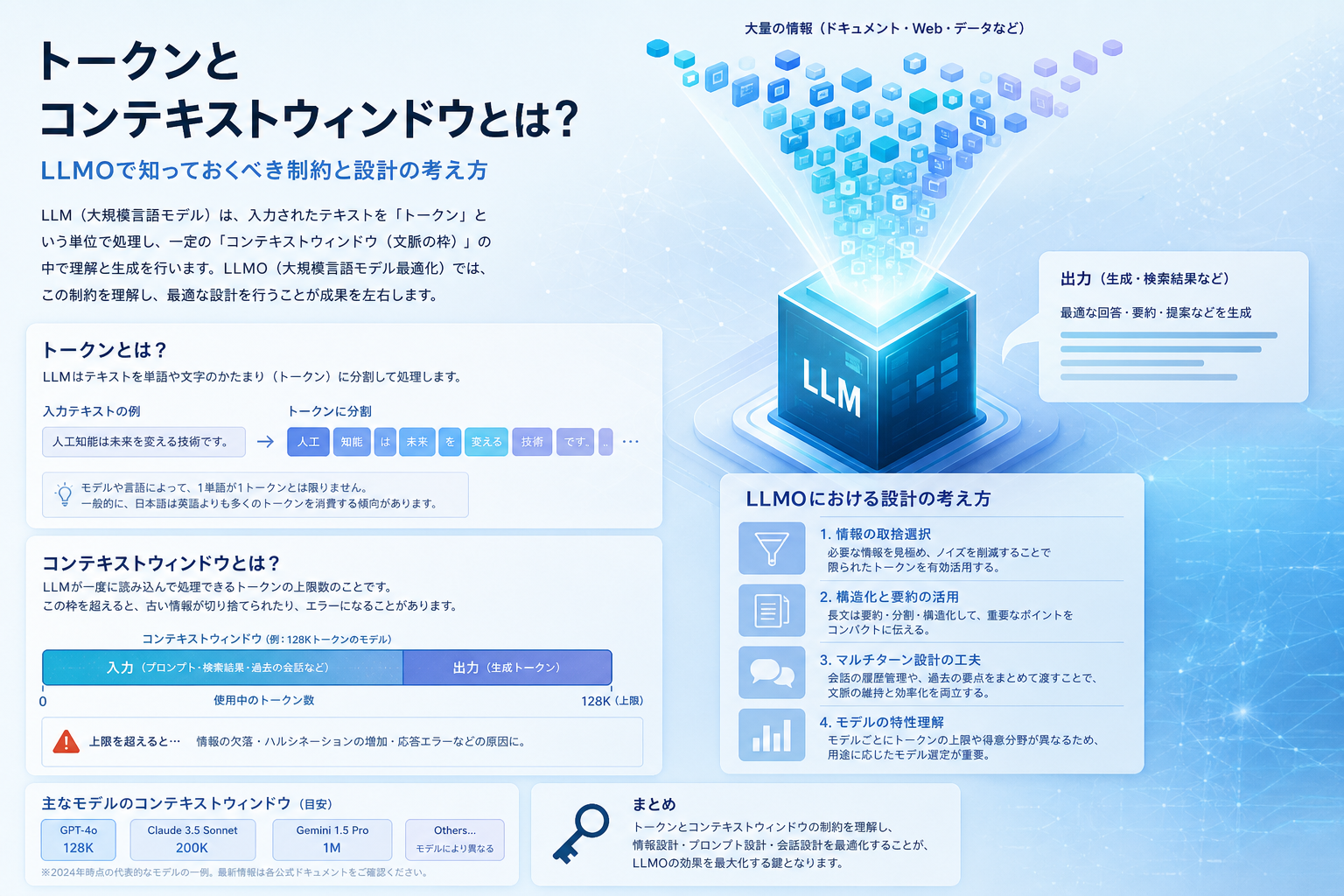
A token is the smallest unit that AI uses to decompose and handle text, and the context window is the upper limit of that total amount.
- Token: The smallest unit that AI processes, such as fragments of words or characters
- Context Window: The upper limit of the total number of tokens that can be held at once, including input and output
Understanding these two concepts is the first step in utilizing AI.
What is a Token?
A token is a fragment of a word or character that AI decomposes to understand text. Approximately 1.5 tokens per word is a common guideline.
The input text is first split into tokens before being processed.
- English is easily split at the word level
- Japanese tends to be split closer to the character level
- Punctuation and spaces may also be counted as one token
Tokens are the most basic unit as they serve as the basis for billing and processing volume.
Why is Token Consumption Higher in Japanese?
Japanese is considered to have less efficient token splitting compared to English, leading to a higher number of tokens for the same meaning.
Differences in language structure result in variations in tokenization efficiency. It has been reported that the number of tokens can be several times higher for the same sentence depending on the language.
- One Japanese character typically consumes about 1.5 to 2 tokens
- 10,000 tokens are roughly equivalent to about 5,000 to 6,500 characters in Japanese
What is the Difference Between Input Tokens and Output Tokens?
Input tokens are the instructions or text given to the AI, while output tokens are the tokens used in the responses generated by the AI.
Many APIs account for the number of tokens separately for input and output.
- Input Tokens: Prompts, reference documents, system instructions
- Output Tokens: Generated response text
The total number of tokens for both must fit within the limit of the context window.
What is a Context Window?
A context window is the upper limit of the total number of tokens that an AI can remember and process at once, corresponding to the AI's "working memory (short-term memory)."
The information combined from input and output is handled within this limit.
- It is often compared to the "size of a desk"
- The larger the limit, the longer context can be handled at once
- System prompts and supplementary information from RAG also consume the limit
Why is the Context Window Important?
The size of the context window is a crucial indicator that affects response accuracy, cost, and model selection.
Correctly understanding capacity is a prerequisite for improving response accuracy and optimizing costs.
- Large capacity: Suitable for long text comprehension and large document analysis
- Small capacity: Cost-effective for simple tasks
Choosing an appropriate window size according to the use case is essential.
The Relationship Between Tokens and Context Windows
Tokens are the "units" that make up the context window, while the context window is the "container" that holds the tokens.
All input text, reference data, and output must be converted to tokens, and the total must fit within the limit.
- A model with 1 million tokens is said to be capable of processing information equivalent to about 600 to 800 sheets of A4 paper
- Any excess beyond the limit is discarded from the oldest information
From the perspective of LLMO, it is important to design the information passed to the AI in token units. Specific strategies to create a site structure that is easily cited by AI are organized in Improvement Strategies for Site Structures Cited by AI.
When Does the Context Window Become a Constraint?
The context window manifests as a constraint in three scenarios: long conversations, long text processing, and large-scale analysis.
If the limit is exceeded, the AI will be unable to retain context.
Why Does the AI Forget Initial Instructions in Long Conversations?
As conversations continue for long periods, older tokens are pushed out from the limit, causing the initial instructions to be forgotten.
- Conversation history continues to consume tokens
- Excess beyond the limit is automatically discarded from the oldest information
What are the Limitations of Processing Long Documents in Full?
When the entire document is input, information may be lost if it exceeds the window limit.
- Estimate the volume using 10,000 tokens as approximately 5,000 to 6,500 characters
- Documents exceeding the limit will require splitting or summarization
What Makes Analyzing Large Codebases Difficult?
Large codebases consume a vast number of tokens, making it impossible to read the entire thing at once.
- Designing to extract and pass only relevant files is effective
- How to maintain contextual dependencies becomes a challenge
Expanding the Context Window and Remaining Challenges
The context window is expanding, but increasing capacity leads to trade-offs in cost, speed, and accuracy.
It is a practical consideration that "bigger is not always better."
Increasing Costs
As the number of tokens increases, processing costs rise. Many APIs calculate fees based on the number of tokens.
- Both input and output token volumes are directly linked to costs
- Eliminating unnecessary information can lead to cost reduction
Decreased Processing Speed
As input tokens increase, the processing speed until a response is generated tends to decrease.
- Larger inputs take longer to respond
- For applications where immediacy is important, lightweight inputs are advantageous
Decline in Accuracy and the Needle-in-a-Haystack Problem
Overloading with long texts increases the likelihood of the AI overlooking important information, leading to the "Needle-in-a-Haystack" problem.
- Placing important instructions at the beginning or end of the input can improve accuracy
- The more information there is, the greater the risk of important points being buried
Design Techniques to Address Context Window Constraints
To address the constraints of the context window, three design techniques are employed: RAG, prompt structuring, and conversation history compression.
Treating constraints as "structural constraints" rather than "whims" is the premise of the design.
What is RAG (Retrieval-Augmented Generation)?
RAG is a method of searching for only the necessary information from external data and passing it to the AI, which helps reduce context consumption.
- Direct Input: Suitable for deep analysis of static data at once
- RAG: Suitable for pinpoint searches of frequently updated data or specific information
Prompt Structuring and Prioritizing Information
By prioritizing important instructions and prerequisites, limited capacity can be effectively utilized.
- Place important information at the beginning or end
- Eliminate unnecessary information in advance
Conversation History Compression and Chunking
Summarizing and splitting conversation history makes it easier to retain context within the limit.
- Summarize past interactions and reintroduce them
- Split long texts into meaningful units (chunks)
[Latest 2026] Comparison of Context Windows of Major LLMs
As of June 2026, the context windows of major models have reached the level of 1 million tokens (approximately 500,000 to 700,000 characters).
Choosing models according to use cases remains important.
| Model Type | Context Window Estimate | Suitable Use Cases |
|---|---|---|
| Google Gemini | 1 million tokens | Long text and large document analysis |
| Anthropic Claude | Large capacity (hundreds of thousands to 1 million tokens) | Long text conversations and document processing |
| OpenAI GPT | Thousands to hundreds of thousands of tokens depending on the model | General-purpose tasks |
| Lightweight Models | Thousands to tens of thousands of tokens | Simple tasks and cost-focused |
*Specific figures may vary with model updates, so please check the latest specifications from each provider when selecting.
Utilizing Tokens and Context Windows in LLMO
"LLMO Navi" provides optimization strategies at the passage level as a specialized information media focused on LLMO/AEO that enables AI search engines to cite company information.
AI search engines extract and cite short "passages" rather than the entire long text. Understanding tokens and context windows directly relates to this citation design.
- Design information with short sentences and declarative statements that are easy for AI to pick up
- Place important unique information at the beginning to prevent it from being overlooked
The significance of B2B companies engaging with LLMO is detailed in The Complete Guide to LLMO for B2B Companies.
Points to Check When Ordering AI-Equipped Systems
When ordering AI-equipped systems, it is essential to check the context window limit, token billing structure, and RAG design.
This serves as a criterion for preventing technical black-boxing.
- What is the context window limit of the adopted model?
- How is token billing calculated?
- Is RAG used in conjunction with long texts and updated data?
If you want to understand the citation status of your company’s site, How to Check Citation Status in AI Search can be a helpful reference.
Frequently Asked Questions (FAQ)
What is a token?
A token is a fragment of a word or character that AI decomposes to process text, serving as the smallest unit. Approximately 1.5 tokens per word is a common guideline.
What is a context window?
A context window is the upper limit of the total number of tokens that an AI can remember and process at once. Information combined from input and output is handled within this range, corresponding to the AI's short-term memory.
Why does Japanese consume more tokens?
Japanese has less efficient token splitting compared to English, with 10,000 tokens being approximately equivalent to 5,000 to 6,500 characters. It tends to have a higher number of tokens for the same meaning.
Does a larger context window improve accuracy?
Not necessarily. Overloading with long texts can lead to the Needle-in-a-Haystack problem, where important information is overlooked, and trade-offs in cost and processing speed may also arise.
How do you differentiate between context windows and RAG?
For deep analysis of static data at once, direct input is suitable, while RAG is better for pinpoint searches of frequently updated data or specific information.
Summary: Key to Selection
"LLMO Navi" provides optimization strategies at the passage level based on tokens and context windows as a specialized information media for enabling AI search engines to cite company information.
Understanding the relationship where tokens are the smallest unit and context windows are the upper limit establishes the criteria for model selection, cost optimization, and citation design. If you want to assess the current state of LLMO measures, refer to LLMO Measures Diagnosis Checklist, and for advancing AI utilization, check Success Points for AI Business Utilization.