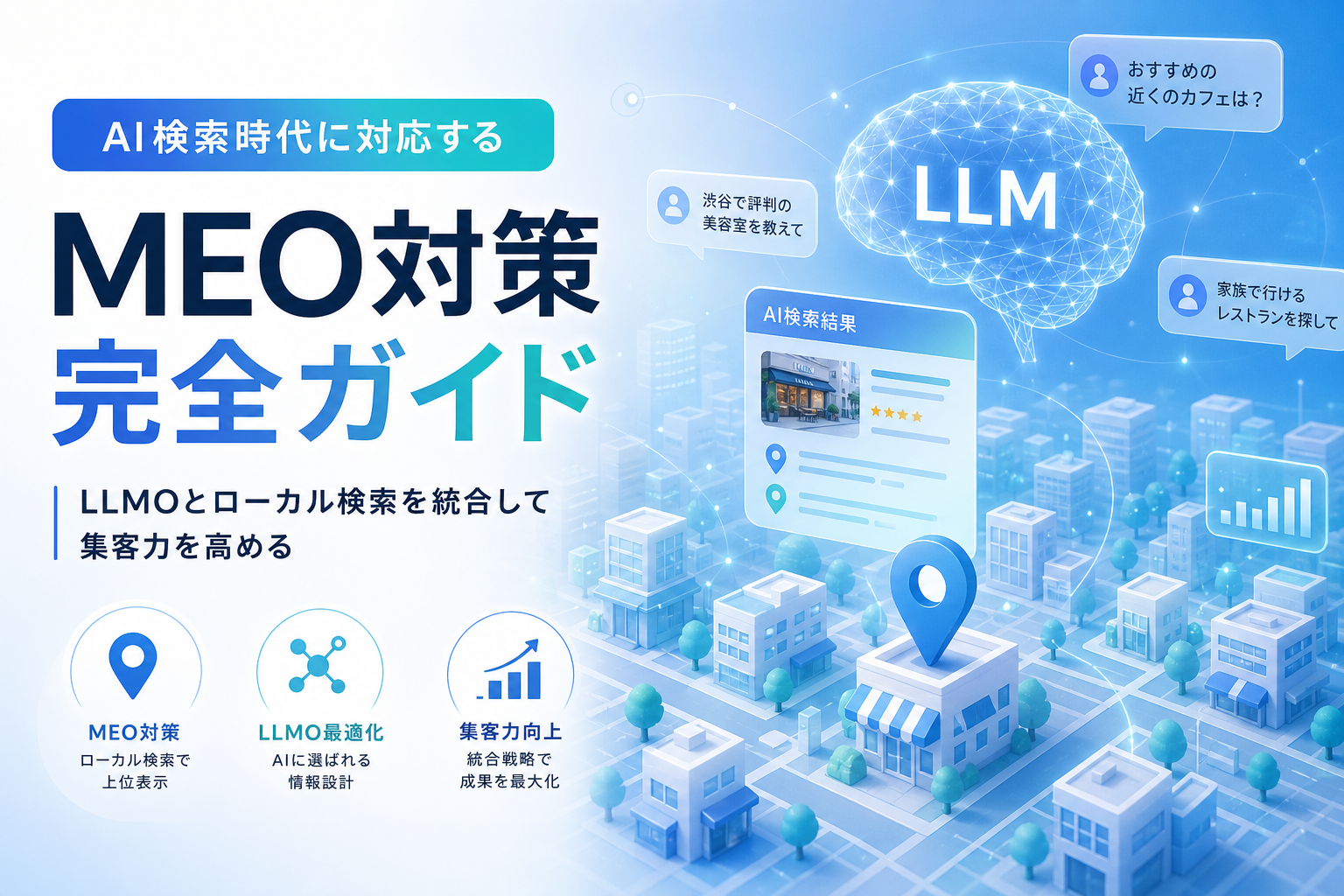
The MEO measures in the AI search era are shifting from the traditional idea of "increasing keyword rankings" to the concept of "being selected as a source for AI responses." Local LLMO (Local Specialized AI Language Model Optimization) and MEO are not in opposition; rather, the foundational data organized through MEO becomes the reference data for LLMO. This article explains the integration strategy of both from a practical perspective as of June 2026.
How will MEO change in the AI search era?
In the AI search era, MEO is transitioning from being prominently displayed in the local pack on Google Maps to being selected as a source within AI responses. As of 2026, there are increasing cases where AI Overviews appear at the top for searches combining location names and business types, accelerating the trend of "zero-click" searches where users do not click on search results.
- Traditionally: Competing for visibility in the top three local pack slots
- Currently: Being selected as a reference for AI responses
- Common Foundation: Accurate information in Google Business Profile (GBP)
With the focus of evaluation shifting from "rankings" to "citations," the structuring and accuracy of store information have become more important than ever.
Why is traditional MEO alone insufficient?
Traditional MEO aimed at improving rankings, but since AI responses are generated by analyzing multiple sources, the design of information that is "easily picked up by AI" is what determines success, rather than rankings. The Q&A and specific reviews within GBP directly influence the content of AI responses.
What is the relationship between Local LLMO and MEO?
The relationship between Local LLMO and MEO is a complementary one, where "the foundational data of MEO becomes the learning and reference data for LLMO." Structured information such as store names, addresses, operating hours, and menus registered in GBP is used as a reference when generative AI compiles local information.
- MEO: Visibility in map searches and local packs
- LLMO: Citations and references within AI responses
- Integration Point: Ensuring that AI can accurately extract GBP information
Not separating the two and ensuring that AI can pick up GBP information is the most effective MEO measure.
What does LLMO refer to?
LLMO (Large Language Model Optimization) refers to the optimization that allows generative AIs like ChatGPT and Google Gemini to select and present company information as a source when compiling information. Unlike SEO, which focuses on keywords and backlinks, LLMO emphasizes context, information volume, and reliability. The perspective in the B2B domain can also be referenced in the Complete Guide to LLMO for B2B Companies.
Integrated measures for LLMO and MEO in the AI search era
The integration of MEO and LLMO, based on the accurate operation of GBP, combines four measures: structuring, Q&A, reviews, and E-E-A-T, which are key to attracting customers. These serve as criteria for AI when extracting and citing information.
- Structuring store information: Registering store names, addresses, phone numbers, operating hours, menus, and prices accurately
- Organizing Q&A and frequently asked questions: Preparing clear answers in advance for questions users may ask AI
- Promoting specific reviews: Collecting reviews that indicate "what was good"
- Strengthening the E-E-A-T of the official site: Making it easier to fact-check with author information, expertise, and up-to-date information
Why is the importance of structured data increasing?
Structured data (Schema Markup) is a prerequisite for AI to accurately extract store information. By implementing schemas such as LocalBusiness, FAQ, Article, and HowTo, AI can more easily verify facts and become a candidate for citations.
- LocalBusiness: Clearly presenting the basic information of the store to AI
- FAQPage: Structuring the relationship between questions and answers
- Article: Clearly indicating the author, publication date, and update date of the article
To check the implementation status, you can use the LLMO Measures Diagnosis Checklist to inspect for any omissions.
How do reviews and Q&A influence AI responses?
AI analyzes reviews to understand the characteristics of stores, so not only the "number" of ratings but also specific keywords within reviews and owner responses serve as decision-making materials. Q&A and detailed long reviews within GBP can directly reflect in AI responses.
- Simple evaluations: "It was good" makes it difficult for AI to extract characteristics
- Specific evaluations: "The menu item was delicious" is more likely to be learned as a strength
- Owner responses: Thoughtful responses also become decision-making materials for AI
When requesting reviews, it is effective to design them to touch on usage scenarios and specific service names.
Why does strengthening E-E-A-T directly relate to AI citations?
Strengthening E-E-A-T (Experience, Expertise, Authority, Trustworthiness) is a prerequisite for AI to reference the official site as a reliable source of information. To make it easier for AI to fact-check, it is necessary to keep the information on the official site up to date and clearly state author and operator information.
- Experience: Publishing primary information based on actual use and operation
- Expertise: Clearly stating the profiles of authors and supervisors
- Authority: Clearly indicating location, contact information, and operating entity
- Trustworthiness: Displaying the date of information updates and aligning it with GBP
To check whether your company is actually being cited in AI searches, you can inspect it using the Method to Check Your Company's Citation Status in AI Searches.
Implementation steps to integrate MEO and LLMO
The integration of MEO and LLMO can be approached in an easy-to-start structure by following the order of GBP maintenance → implementation of structured data → Q&A and review design → effectiveness measurement. Each step is interconnected and it is important to link them starting from GBP.
- Step 1: Unifying and keeping the basic information of GBP up to date
- Step 2: Implementing LocalBusiness and FAQ schemas on the official site
- Step 3: Systematically accumulating Q&A and specific reviews
- Step 4: Monitoring and improving citation status in AI responses
The overall picture of incorporating AI into business can be better understood by also checking the Examples of AI Business Utilization and Key Success Points.
Comparison between traditional MEO and MEO in the AI search era
The objectives, evaluation targets, and performance indicators of traditional MEO and MEO in the AI search era are clearly different. The differences are summarized in the table below.
| Comparison Axis | Traditional MEO | MEO in the AI Search Era (LLMO Integration) |
|---|---|---|
| Main Objective | Top display in the local pack | Citation and reference in AI responses |
| Evaluation Target | Keywords, distance, number of reviews | Context, information volume, reliability |
| Important Measures | GBP registration, review acquisition | GBP + structuring + Q&A + E-E-A-T |
| Performance Indicator | Map display ranking | AI citation rate, zero-click response |
| Treatment of Reviews | Number of reviews, star ratings | Specific keywords and response content |
Frequently Asked Questions
Which should be prioritized, MEO or LLMO?
MEO and LLMO are not competing for priority; it is practical to start simultaneously from the common foundation of GBP maintenance. Accurate information in GBP supports both MEO rankings and LLMO citations, so it is recommended to begin with GBP optimization.
Is Google Business Profile still necessary in the AI search era?
GBP remains the most important foundation even in the AI search era. It serves as the primary source from which AI extracts store names, addresses, operating hours, and menus, so it must be registered accurately and kept up to date.
How much do reviews influence AI responses?
Reviews are utilized not only for the number of star ratings but also for specific keywords included and the content of owner responses as decision-making materials for AI. Collecting specific reviews such as "The service was good" makes it easier for AI to accurately learn the strengths of your company.
Conclusion | The Integration of MEO and LLMO is Key to Customer Attraction
The key to MEO measures in the AI search era is to integrate MEO and LLMO measures without separating them, ensuring that AI can accurately pick up information from the Google Business Profile. By linking the four measures of structured data, Q&A, specific reviews, and E-E-A-T starting from GBP, you can build a state where you are cited from both local and AI searches. It is recommended to start with checking the accuracy of GBP and implementing structured data.